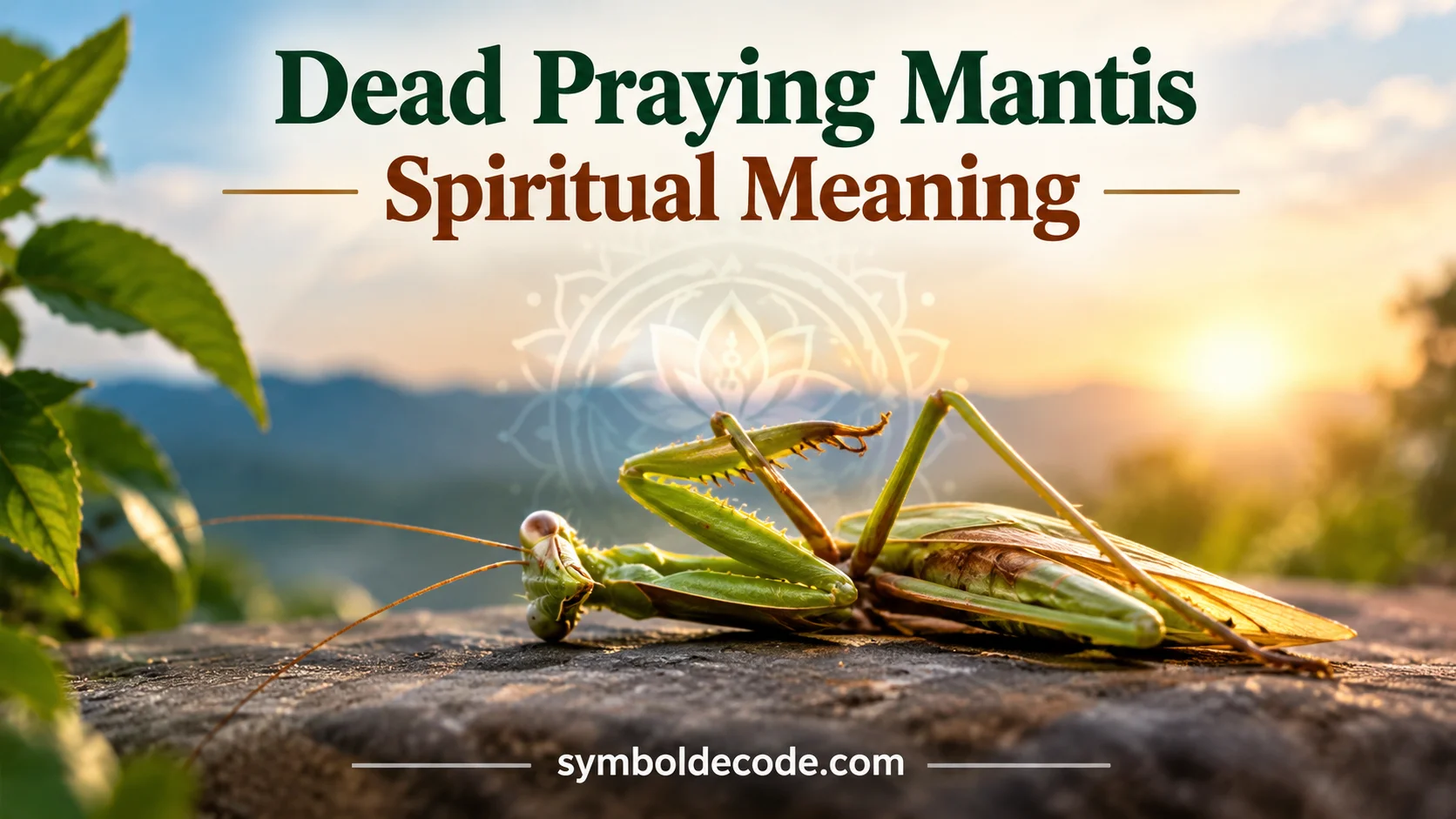
The Dead Praying Mantis Spiritual Meaning often relates to transformation, change, patience, and the end of an important life stage. In different cultures, the praying mantis symbolizes mindfulness, awareness, stillness, and spiritual growth. Finding a dead mantis may encourage you to reflect on personal experiences, release old habits, and welcome new opportunities. However, these spiritual interpretations are personal beliefs, not proven supernatural messages or predictions about your future.
Throughout history, the praying mantis has held spiritual significance in several cultural traditions. Some African traditions associate the mantis with Kaggen, while Ancient Greeks connected it with spiritual perception and Ancient Egyptians viewed it as a guide for the dead. Today, its symbolism may represent wisdom, inner peace, transition, and personal reflection. Rather than treating its death as a warning, consider how this encounter might inspire self-awareness, emotional understanding, and a fresh perspective on life’s changes.
Quick Answer
The dead praying mantis spiritual meaning in the United States is commonly interpreted through themes of closure, transformation, patience, and letting go. Spiritually, some people view it as a reminder to reconsider their direction, accept change, or begin a new chapter. These are personal interpretations, not proven predictions or universal spiritual rules.
TL;DR
- Endings: A life phase or familiar pattern may be reaching its conclusion.
- Transformation: Change can create room for new priorities and growth.
- Patience: The mantis symbolizes the value of waiting and observing.
- Letting go: Its death can prompt reflection on attachments that no longer help.
- Awareness: The encounter may encourage greater attention to your surroundings.
- Natural cycles: The insect’s death also reflects ordinary processes within nature.
1. What Does a Dead Praying Mantis Symbolize?
A dead praying mantis can represent the closing of a chapter, a change in perspective, or the need to release something familiar. In American spiritual discussions, people often connect this insect with patience and stillness because of its distinctive posture and careful movements.
However, death changes the focus of the symbol. Instead of emphasizing waiting and preparation, people may interpret the insect’s death as a reminder that every stage has an ending.
The Main Symbolic Meanings
- Closure: Accepting that a relationship, habit, or life stage may have ended.
- Transformation: Recognizing that personal growth often follows periods of change.
- Lost patience: Reflecting on situations where waiting no longer serves your needs.
- Awareness: Paying closer attention to choices you’ve been postponing.
- Renewal: Making room for different goals after releasing outdated expectations.
These meanings aren’t fixed rules. Your own experience may shape whether the encounter feels peaceful, sad, unsettling, or simply interesting.
Why Its Death Matters Symbolically
A living mantis often suggests alertness, precision, and quiet strength. A dead one introduces themes of stillness, finality, and the natural limits of life.
For example, someone facing a career change might interpret the encounter as a reminder to leave an outdated role behind. Another person may see nothing spiritual in it, and that’s equally reasonable.
2. Historical Origins of Praying Mantis Symbolism
The praying mantis has attracted human attention for centuries because of its unusual shape and behavior. Its history includes ancient language, traditional storytelling, artistic representations, and observations of the natural world.
However, historical respect for the living insect doesn’t establish one universal meaning for a dead mantis.
Ancient Greek and European Associations
The word mantis comes from ancient Greek and is associated with a prophet or seer. The insect’s raised front legs also resemble a person holding their hands in prayer, which influenced its name and later spiritual associations.
In European traditions, this posture encouraged people to associate the insect with prayerfulness, contemplation, and mystery. Later religious interpretations sometimes emphasized its apparent stillness.
Still, these associations describe how people interpreted the insect’s appearance. They don’t demonstrate that ancient societies shared a single belief about finding one dead.
From Natural Observation to Spiritual Interpretation
As natural history developed, observers studied the mantis as a predator with specialized front legs and remarkable hunting behavior. Its ability to remain still before striking made it an appealing image of patience and focused action.
Today, spiritual writers often extend those qualities to personal experiences. The death of the insect then becomes a metaphor for an ending or a change in direction.
3. Dead Praying Mantis Spiritual Meaning in American Culture
In the United States, the praying mantis is familiar to many people through gardens, outdoor spaces, nature programs, and childhood encounters with insects. Its unusual appearance makes it memorable, while its stillness can seem almost human.
Consequently, a dead mantis may invite both practical curiosity and personal reflection.
Nature and Everyday American Life
American garden culture often presents mantises as fascinating predators that feed on other insects. Gardeners may notice them on flowers, fences, shrubs, or vegetable plants.
When someone discovers a dead mantis, the setting can influence the personal interpretation.
- In a backyard: A reminder of seasonal changes and natural cycles.
- Near a doorway: A personal symbol of transition or a new chapter.
- On a garden plant: An invitation to reflect on growth and changing priorities.
- Along a walking path: A moment to slow down and notice your surroundings.
These are modern symbolic readings rather than established American folk rules.
Individual Beliefs and Personal Meaning
Americans approach spirituality in different ways. Some interpret animal encounters through religious faith, while others draw on meditation, personal intuition, or nature-based practices.
For one person, a dead mantis might inspire gratitude for nature. For another, it might symbolize the end of a difficult period.
Neither interpretation needs to be treated as an objective message from the universe. Personal meaning can be valuable without requiring certainty about supernatural causes.
4. Is a Dead Praying Mantis a Good or Bad Omen?
Finding a dead praying mantis isn’t automatically a good omen or a bad one. Some spiritual interpretations associate it with necessary endings, while others emphasize reflection, renewal, or the importance of releasing old habits.
The insect’s death alone cannot predict future events.
Positive Interpretations
A positive interpretation focuses on what an ending might make possible. The mantis can become a symbol of acceptance, emotional growth, and the freedom to reconsider familiar routines.
You might connect the encounter with:
- Releasing an expectation that no longer fits your life.
- Accepting that a difficult season has passed.
- Becoming more thoughtful before making important decisions.
- Recognizing that rest and change are parts of growth.
Negative Interpretations
Some people may associate a dead animal with loss, spiritual disconnection, or a warning to pay attention. These ideas belong to particular spiritual interpretations, not universal traditions.
It’s important not to assume that the mantis predicts illness, financial trouble, relationship problems, or another misfortune.
Instead, consider whether the encounter brings up an existing concern. You can use that awareness to reflect without allowing fear to control your decisions.
5. Spiritual Meaning of a Dead Praying Mantis in Your House
Finding a dead praying mantis inside your home can feel especially noticeable because the insect seems out of place. In symbolic interpretations, a house often represents personal life, privacy, security, and emotional space.
However, a mantis inside your home may simply have entered through an open door or window.
Symbolism of the Home
Some people interpret a dead mantis indoors as a prompt to reconsider their home environment or personal boundaries. The meaning often depends on what’s happening in their lives.
- Peace at home: A reminder to appreciate stability and quiet moments.
- Family changes: A symbol of adjusting to a new household situation.
- Emotional boundaries: An invitation to reconsider what you allow into your personal space.
- Decluttering: A metaphor for releasing objects, routines, or expectations you no longer need.
These interpretations can help you explore your feelings, but they shouldn’t be treated as evidence of negative energy.
What Should You Do?
You don’t need to perform a special ritual or worry that the insect’s presence has changed your home’s spiritual condition.
If the discovery feels meaningful, pause and consider what the idea of closure brings to mind. Otherwise, dispose of the insect normally and continue with your day.
6. Dead Praying Mantis Meaning for Love and Relationships
In relationships, a dead praying mantis may symbolize changing expectations, the end of an unhealthy pattern, or a need for more thoughtful communication. Its usual associations with patience and precision can offer a useful way to reflect on how you relate to others.
Importantly, it doesn’t prove that a breakup is coming or that another person has hidden intentions.
Love, Closure, and Emotional Change
Sometimes relationships change without ending completely. A friendship may become more distant, a family relationship may require new boundaries, or a romantic partnership may enter a different stage.
In this context, the dead mantis can represent acceptance rather than loss alone.
Consider these possible reflections:
- Letting go: Are you holding onto a relationship that has already changed?
- Patience: Have you waited too long to discuss an important concern?
- Boundaries: Are your needs receiving the same attention as someone else’s?
- Renewal: Could a difficult conversation help create a healthier connection?
Does It Mean a Relationship Is Ending?
No reliable evidence connects finding a dead praying mantis with a specific romantic outcome.
If you associate the encounter with a relationship, use it as a starting point for honest reflection. Actual communication and behavior offer much better guidance than interpreting an insect as a prediction.
7. Dead Praying Mantis Meaning for Career and Life Direction
A dead praying mantis may symbolize the end of an approach that once helped you but no longer fits your circumstances. In a career context, that idea can relate to changing ambitions, leaving an outdated routine, or reconsidering how you use your time.
Its symbolism can encourage thoughtful action rather than sudden decisions.
Work and Personal Ambitions
The living mantis is known for waiting before acting. Symbolically, this suggests preparation and timing, while its death may shift attention toward knowing when to stop waiting.
You might reflect on the following:
- Career closure: Is a professional chapter naturally reaching its end?
- Decision-making: Are you delaying a choice because uncertainty feels uncomfortable?
- Personal growth: Have your goals changed since you first chose your direction?
- Balance: Does your current routine leave enough room for rest and relationships?
When to Take Action
A symbolic encounter doesn’t tell you whether to quit a job, change careers, or abandon a goal. Those choices deserve careful consideration of your actual circumstances.
Instead, use the mantis as a reminder to review your priorities. Sometimes the right response is to act, while at other times it is to gather more information and wait.
Read More: Itchy Right Elbow Spiritual Meaning
8. Cross-Cultural and Spiritual Interpretations
Praying mantises have appeared in different cultural settings, although their meanings vary. Their unusual posture, hunting behavior, and relationship with agricultural environments have influenced how people represent them.
It’s important to distinguish documented cultural history from modern spiritual interpretations of a dead mantis.
East Asian Cultural Associations
In Japan, praying mantises appear in historical decorative art. The Metropolitan Museum of Art notes that Japanese artists used insect imagery to represent seasonal changes and wishes for a fortunate life.
The mantis has also appeared in Chinese stories, including tales in which a smaller creature boldly confronts a stronger opponent. These associations can suggest courage, determination, or the risks of overconfidence.
Such examples concern the mantis as a cultural symbol. They don’t establish one shared East Asian interpretation of finding a dead insect.
Broader Spiritual Perspectives
In modern spiritual writing, the praying mantis is frequently associated with mindfulness, stillness, patience, and intuition.
Some nature-centered spiritual practices encourage people to treat encounters with animals as opportunities for reflection. In that setting, a dead mantis might prompt thoughts about mortality, gratitude, or life’s changing stages.
However, beliefs differ widely, even within the same religious or cultural community. There is no single spiritual interpretation that everyone must follow.
Respecting Cultural Differences
Avoid assuming that a particular culture views a dead mantis as sacred, unlucky, or prophetic without reliable evidence.
A respectful approach recognizes documented traditions while allowing individuals to develop their own personal meanings. This also helps prevent modern internet interpretations from being mistaken for ancient teachings.
9. Psychological Meaning of Seeing a Dead Praying Mantis
The psychological meaning of an encounter often depends on attention, emotion, and personal circumstances. When something unusual catches your eye, your mind may connect it with a concern or transition already occupying your thoughts.
That process can make the moment feel personally significant without requiring a supernatural explanation.
Why the Encounter Feels Meaningful
The praying mantis has a distinctive appearance. Its folded legs, triangular head, and still posture can make it seem unusually expressive compared with many other insects.
When you find one dead, the contrast between its familiar posture and its lack of movement may encourage thoughts about change or finality.
Your interpretation may also be influenced by recent experiences:
- A recent loss may make the insect symbolize grief or acceptance.
- A major decision may make it represent uncertainty or change.
- A stressful period may lead you to associate it with the need for rest.
- A peaceful moment may inspire gratitude for nature and ordinary life.
Reflection Without Fear
Humans naturally search for patterns and meaning, especially during uncertain periods. This ability can support creativity and self-understanding, but it can also make coincidences seem more predictive than they are.
Rather than asking whether the mantis guarantees something will happen, ask what the encounter reminds you to consider. That approach preserves personal meaning without turning an ordinary event into a source of anxiety.
10. Dead Praying Mantis in Dreams, Tattoos, and Modern Media
Modern symbolism extends beyond physical encounters. People may use the praying mantis in dreams, artwork, tattoos, jewelry, and online discussions to express ideas about stillness, change, and the natural world.
A dead mantis adds a visual contrast between the insect’s familiar alertness and its final stillness.
Dream Interpretations
Dreams involving dead insects can reflect personal concerns, recent experiences, or images encountered during waking life. There is no universal dream dictionary that can establish exactly what a dead mantis means.
Depending on the dream, it might represent:
- An ending you’ve been reluctant to acknowledge.
- A change in your approach to a difficult situation.
- Concern about losing patience or control.
- Acceptance of something you cannot change.
The emotions in the dream may be more informative than the insect alone. Fear, sadness, relief, and curiosity can each suggest a different personal association.
Tattoos and Artistic Expression
A praying mantis tattoo can express patience, precision, resilience, or an appreciation for unusual wildlife. A design featuring a dead mantis may instead explore mortality, transformation, or the contrast between beauty and decay.
In the United States, insect tattoos can also reflect individuality and interest in the natural world. Their meanings remain personal rather than universal.
Social Media and Online Symbolism
Online spiritual communities often discuss animal encounters as possible signs or messages. These conversations can introduce people to unfamiliar interpretations, but repeated claims don’t necessarily establish historical or spiritual facts.
Treat online meanings as ideas to consider rather than instructions you must follow.
11. Misunderstandings About Dead Praying Mantis Symbolism
Because the praying mantis looks unusual, it’s easy to attach dramatic meanings to its appearance. However, a careful interpretation separates natural explanations, cultural associations, and personal beliefs.
Common Myths and Misconceptions
| Claim | More Balanced Interpretation | Important Note |
| A dead mantis predicts bad luck. | Some people associate it with endings or caution. | No reliable evidence establishes it as an omen. |
| Finding one means a relationship will end. | It may prompt reflection on relationships. | It cannot predict another person’s behavior. |
| The insect carries a supernatural warning. | The encounter may feel personally meaningful. | Personal significance isn’t proof of a supernatural message. |
| A dead mantis means negative energy is present. | Some spiritual beliefs use this interpretation. | The insect’s presence doesn’t establish an energy problem. |
| Every mantis encounter has a hidden meaning. | People differ in how they interpret nature. | An ordinary explanation may be sufficient. |
Understanding Natural Causes
Praying mantises have a limited life cycle. In many temperate regions of the United States, adults reproduce in the warmer months and die as they age or when cold weather arrives. Their egg cases can survive the winter and release young mantises later.
Other possible causes of death include predators, injury, and environmental conditions.
Knowing these facts doesn’t prevent you from finding personal meaning in the encounter. Instead, it helps you avoid confusing symbolic interpretation with biological evidence.
Avoiding Fear-Based Interpretations
Be cautious of anyone claiming that a dead mantis guarantees misfortune or requires an expensive spiritual remedy. Such claims can turn natural events into unnecessary sources of fear.
A grounded interpretation leaves room for curiosity, personal belief, and ordinary explanations.
12. What to Do When You Find a Dead Praying Mantis
Finding a dead mantis doesn’t require a spiritual response. However, if the encounter feels significant to you, a few simple practices can turn the moment into an opportunity for thoughtful reflection.
Pause and Notice Your Feelings
Before assigning a meaning, consider your immediate reaction. You might feel sadness, surprise, curiosity, or nothing in particular.
Then ask yourself:
- What was I thinking about when I noticed the insect?
- Am I currently facing an ending or major change?
- Is there a habit or expectation I need to reconsider?
- Can I reflect on this moment without expecting a prediction?
These questions help you develop a personal interpretation without assuming that the mantis appeared specifically for you.
Choose a Simple, Respectful Response
If you’d like to acknowledge the encounter, you can quietly appreciate the insect’s place in nature. Some people prefer a short moment of silence, prayer, or journaling.
You don’t need a ritual to prevent bad luck or secure a particular outcome.
If you handle the insect, avoid touching it with bare hands when possible. Use a piece of paper or gloves to move it, then wash your hands. If you prefer, you can simply leave it undisturbed.
Turn Reflection Into a Useful Action
The most constructive interpretation is one that helps you think clearly about your real life.
For example, if the mantis reminds you of an ending, consider what you’ve learned from that experience. If it makes you think about patience, decide whether waiting or taking action makes more sense in your current situation.
Let the symbolism support your judgment rather than replace it.
FAQs:
1. What Does a Dead Praying Mantis Mean Spiritually?
Spiritually, a dead praying mantis is often interpreted as a symbol of closure, transformation, patience, and letting go. However, these meanings vary between individuals and spiritual traditions, and none is a universal rule.
2. Is Finding a Dead Praying Mantis Bad Luck?
No established evidence shows that finding a dead praying mantis causes bad luck. Some people interpret it as a reminder to reflect on change, while others see it as an ordinary event in nature.
3. What Does a Dead Praying Mantis Mean in Your House?
Some people associate a dead mantis indoors with changes in personal life, family relationships, or emotional boundaries. However, the insect may simply have entered through an open door or window and died naturally.
4. Does a Dead Praying Mantis Mean Transformation?
It can symbolize transformation in modern spiritual interpretations because death represents an ending and the mantis is associated with patience and awareness. This is a metaphor for personal reflection, not proof that a major change is coming.
5. What Does It Mean if You Dream About a Dead Praying Mantis?
A dream about a dead mantis might reflect thoughts about closure, uncertainty, or a changing situation. Your personal experiences and emotions are important when considering what the dream means to you.
6. Is a Dead Praying Mantis a Message From the Universe?
Some spiritual beliefs encourage people to interpret animal encounters as meaningful signs. However, there is no reliable way to establish that a dead mantis is a message from the universe, so it’s best to treat that possibility as a personal belief.
Conclusion:
The dead praying mantis spiritual meaning is often connected with endings, transformation, patience, and letting go. In modern American symbolism, this unusual insect can serve as a reminder to reconsider old patterns, accept natural changes, and approach important decisions with greater awareness. However, finding a dead mantis does not automatically mean something good or bad will happen. Its death may have a simple biological explanation, and any spiritual significance depends on your personal beliefs and circumstances. If the encounter stays in your mind, take a moment to reflect on what it brings up for you. Perhaps it reminds you to release an old expectation, appreciate the present, or recognize that some chapters end naturally. You can welcome this personal reflection without fear or the need to treat it as a prediction.