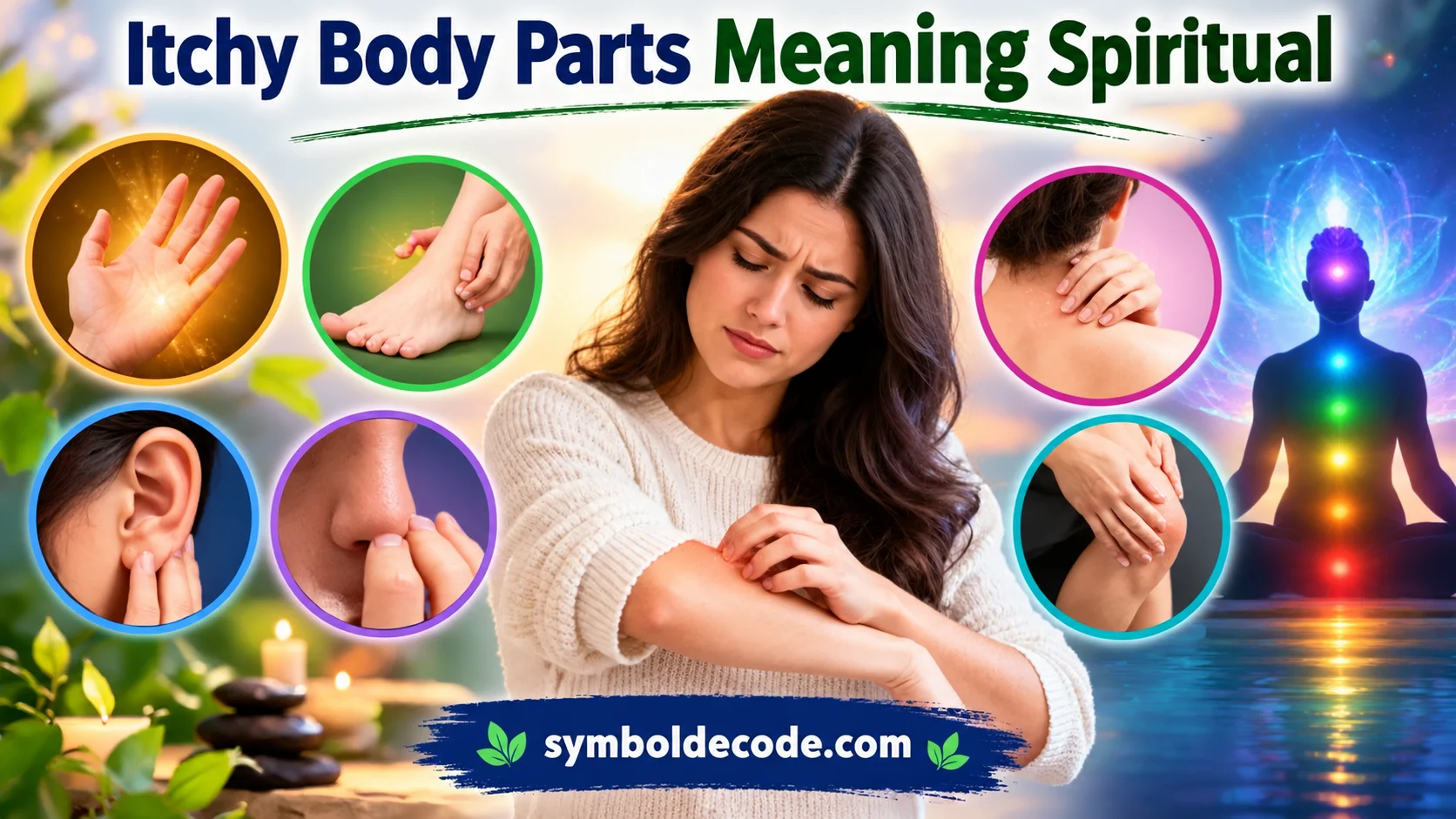
Itchy Body Parts Meaning Spiritual can connect itching with cultural beliefs and personal reflection. Skin has held spiritual aspects since ancient times because it is visible, touchable, and connected with the self and others. As a sensory organ, it reflects emotions through redness, warmth, coldness, goose bumps, and sweating. Different religious significances also involve coverings, tattooing, shaving, styling, and decorating the skin.
Itching may have different cultural interpretations and superstitions that try to predict outcomes. Skin disorders such as psoriasis, leprosy, and vitiligo have also carried religious aspects across major religions and traditions. Hives, or urticaria, can create itchy red welts and may appear after stress or a reaction involving histamines. When symptoms become chronic, a doctor can help with suitable treatments and medications.
Quick Answer
Itchy body parts meaning spiritual is commonly associated with change, awareness, movement, emotional restlessness, and personal growth. In American folklore, specific areas may carry more traditional meanings, such as money for itchy palms or travel for itchy feet.
TL;DR
- Itching can symbolize change, movement, awareness, or emotional restlessness.
- American folklore often connects itchy palms with money.
- Itchy feet commonly represent travel or a new direction.
- Itchy ears can symbolize gossip, attention, or being remembered.
- Spiritual interpretations vary widely between cultures and families.
- Physical itching can also have ordinary causes unrelated to symbolism.
What Does an Itchy Body Symbolize Spiritually?
An itchy body can become symbolic when a physical sensation suddenly captures your attention. Spiritual interpretations often treat that moment as an invitation to pause and consider what is happening emotionally or personally.
For many people, the body becomes a metaphorical language. Hands can represent giving and receiving, feet can represent movement, and the head can represent thoughts.
Common Spiritual Themes
The most common symbolic interpretations include:
• Change — something in life may feel ready to shift.
• Awareness — an unusual sensation can encourage greater attention.
• Restlessness — you may feel ready to leave a stagnant situation.
• Growth — discomfort can symbolize adjustment during personal development.
• Release — an itch can represent letting go of old emotional patterns.
• Intuition — some people view bodily sensations as prompts for reflection.
These meanings are symbolic rather than guaranteed. An itch doesn’t provide a fixed message that everyone must interpret in the same way.
Why Location Matters
Body symbolism often comes from everyday human experience. Hands handle objects and money, feet carry us toward new places, and ears receive sounds and words.
Because of that, people naturally connect sensations in those areas with related themes.
What Is the History of Itching Superstitions?
Beliefs about bodily sensations are much older than modern spirituality. Ancient writers recorded ideas about ears, dreams, bodily movements, and other physical signs being connected with social or future events.
The important point is that there isn’t one ancient system explaining every itchy body part. Instead, different traditions developed separate beliefs that later became mixed together.
Ancient and Early Roots
Roman writer Pliny the Elder described an old belief that glowing or tingling ears meant someone was talking about a person. Shakespeare also used similar ear imagery in Much Ado About Nothing.
By the early modern period, European folk traditions contained many body-related omens. Itching, ringing, tingling, sneezing, and other sensations could become signs connected with visitors, money, gossip, or travel.
From Folklore to Modern Spirituality
Over time, these beliefs moved through families, communities, books, newspapers, and popular culture. American folklore preserved many European traditions while also developing its own local variations.
Today, social media has expanded the conversation. A simple family superstition can now be presented as a broad spiritual interpretation, even when its original meaning was much narrower.
What Does an Itchy Palm Mean Spiritually?
An itchy palm is probably the best-known example of body itching connected with fortune. In American folklore, it is commonly associated with money arriving or leaving.
However, there has never been one universal rule about which hand represents which outcome. Some American traditions favor the right hand for receiving money, while others reverse the sides.
Money and Exchange
The symbolism makes practical sense. Hands have always been involved in earning, receiving, giving, counting, and exchanging money.
That everyday connection helped turn an ordinary palm sensation into a financial omen.
| Body Area | Common U.S. Symbolism | Common Association | Important Note |
| Palm | Money or exchange | Wealth, giving, receiving | Left-right rules vary |
| Foot | Travel or movement | Journey, direction | Often linked with restlessness |
| Ear | Someone talking about you | Gossip, praise, attention | Versions differ by side |
| Nose | Visitor or social event | Company, news, interaction | Several traditions exist |
| Head | Thought or awareness | Insight, reflection | Mostly modern interpretation |
Receiving More Than Money
Modern spiritual interpretations sometimes broaden the idea of receiving. An itchy palm may symbolically represent receiving support, affection, opportunity, knowledge, or recognition.
This approach shifts the meaning from a literal financial prediction toward a broader question: What am I ready to receive?
What Does an Itchy Foot Mean Spiritually?
An itchy foot has long been associated with movement. In American folklore, the familiar expression “itchy feet” often describes someone who wants to travel or leave a familiar place.
The spiritual interpretation builds on that same idea. An itchy foot may symbolize a desire for progress, exploration, or a new direction.
Movement and New Paths
Feet physically carry you forward. Therefore, they easily become symbols of life’s journey.
An itchy foot may represent:
• A desire to travel somewhere unfamiliar.
• Restlessness with your current routine.
• Readiness to begin a different chapter.
• A need to make an important decision.
• Curiosity about opportunities beyond your comfort zone.
• A symbolic push toward greater independence.
Some traditions assign different meanings to the right and left foot. Those details vary so much that it’s better to treat them as cultural folklore rather than universal rules.
What Does an Itchy Ear Mean Spiritually?
Itchy ears are closely connected with old beliefs about conversation and social attention. One traditional idea says that an itching or burning ear means someone is talking about you.
Different traditions may associate one ear with praise and the other with criticism.
Hearing Beyond the Literal
The symbolism is especially interesting because ears represent listening. An itchy ear can therefore become a metaphor for paying attention to what people are saying.
In a modern reflective sense, it might encourage you to consider:
• Whether you’re listening carefully to someone important.
• Whether gossip is affecting your emotional state.
• Whether you need to communicate more clearly.
• Whether you’ve been ignoring useful feedback.
• Whether someone else’s opinion occupies too much attention.
The spiritual interpretation doesn’t prove that another person is talking about you. Instead, it can offer a meaningful prompt to examine communication and relationships.
What Does an Itchy Nose Mean Spiritually?
An itchy nose has several traditional meanings in American and broader English-language folklore. One of the most familiar versions suggests that company or a visitor is coming.
Other traditions connect the nose with gossip, conflict, news, or even a coming social encounter.
A Symbol of Incoming Events
The nose sits at the center of the face and constantly responds to the surrounding environment. Symbolically, this makes it easy to associate with sensing something before it arrives.
A modern interpretation may therefore focus less on predicting a literal visitor. Instead, the itch can represent anticipation, curiosity, or awareness that something in your social world is changing.
What Does an Itchy Head or Scalp Mean Spiritually?
The head is commonly associated with thought, identity, awareness, and personal understanding. Modern spiritual discussions sometimes interpret an itchy head as a symbol of mental activity or new insight.
Unlike itchy palms and feet, this interpretation is less firmly rooted in one widely recognized American superstition.
Thoughts and Awareness
An itchy head may symbolically represent:
• Mental restlessness or an active imagination.
• A desire to understand something more deeply.
• New ideas competing for your attention.
• A need to slow down and reflect.
• Personal growth through learning or self-awareness.
Some spiritual traditions also connect the top of the head with higher consciousness. That interpretation belongs to particular spiritual frameworks and shouldn’t be treated as a universal religious teaching.
Read More: Left Leg Pain Spiritual Meaning
What Does an Itchy Back Mean Spiritually?
The back can carry strong metaphorical meaning because people often describe responsibilities as burdens they “carry.” For this reason, modern spiritual interpretations sometimes connect an itchy back with emotional weight or unresolved pressure.
Burdens and Boundaries
An itchy back may encourage reflection around responsibilities, relationships, and personal limits.
You might ask yourself:
• What responsibility feels heavier than usual?
• Am I carrying someone else’s emotional problems?
• Where do I need stronger personal boundaries?
• What old situation still bothers me?
This doesn’t mean the itch proves you are carrying negative energy. Instead, the symbolism can help you explore what has been emotionally difficult.
What Do Itchy Arms, Legs, or Shoulders Mean?
Larger limbs often receive symbolic meanings based on their physical functions. Arms reach, hold, work, protect, and embrace. Legs support movement, while shoulders are often associated with responsibility.
Symbolic Body Connections
Modern interpretations may connect these areas with:
• Arms: action, connection, giving, and reaching outward.
• Legs: stability, progress, and personal direction.
• Shoulders: responsibility, pressure, and emotional burdens.
• Elbows: flexibility, adaptation, and changing direction.
• Knees: movement, humility, and willingness to adjust.
These interpretations are mostly metaphorical. Their value comes from personal reflection rather than a fixed spiritual dictionary.
Can Itching Represent Spiritual Awakening?
Some modern spiritual traditions describe unusual sensations as signs of increased awareness or spiritual awakening. Itching may be interpreted as energy shifting, emotional release, or becoming more sensitive to one’s inner experience.
However, there is no universal spiritual rule stating that itching means awakening.
Awakening as a Reflection
If you’re going through major personal changes, an unusual sensation may simply make you pause. That pause can still become meaningful.
Instead of asking only, “What supernatural message is this?” you might also ask, “What has been changing in my life lately?”
That question keeps the experience grounded while leaving room for personal spirituality.
What Is the Emotional Meaning of an Itchy Body?
The emotional symbolism of itching often centers on irritation, impatience, restlessness, and the desire to resolve something.
The language we use every day supports this connection. People say that something is “bugging” them or that they feel an “itch” to do something.
Restlessness and Inner Pressure
An itch demands attention. Emotionally, unresolved concerns can behave in a similar way.
You may experience a symbolic itch when:
• A decision has been delayed for too long.
• A relationship feels uncomfortable or uncertain.
• A routine has become emotionally stale.
• You want change but fear the consequences.
• An old memory keeps returning to your thoughts.
• You feel ready to express something important.
This interpretation treats the sensation as a metaphorical prompt, not proof of an emotional cause.
What Does Itchy Body Parts Mean in American Folklore?
American folklore contains many body-related superstitions. Some came through European traditions, while others developed through regional family customs and community storytelling.
The meaning could change from one state, family, or generation to another.
Familiar American Beliefs
Common examples include:
• An itchy palm may be connected with money.
• Itchy feet may suggest an upcoming trip.
• An itchy nose may signal company.
• Itchy ears may suggest someone is talking about you.
• Tingling ears may be linked with gossip or attention.
• Other sudden sensations may be treated as personal omens.
The James T. Callow Folklore Archive, for example, contains American records of itchy feet being connected with taking a trip. Such records show how these beliefs existed as everyday folklore rather than as one formal spiritual system.
How Do Different Cultures Interpret Itching?
Itching symbolism appears across many cultures, but the meanings aren’t identical. The same body part can carry opposite interpretations depending on local traditions.
This variation is important because it prevents one culture’s belief from being presented as universal.
Different Cultural Patterns
A few broad patterns appear repeatedly:
• Hands are often connected with giving, receiving, or money.
• Feet frequently represent travel, movement, or life direction.
• Ears can symbolize communication, gossip, or social attention.
• The nose may represent visitors, news, or interpersonal events.
• The head can represent thought, awareness, or spiritual connection.
These similarities don’t prove one worldwide origin. In many cases, people independently connect body functions with symbolic ideas.
Is There a Difference Between Left and Right Itching?
Many traditions give separate meanings to the left and right sides of the body. However, these rules often conflict.
For example, one tradition may say an itchy right palm brings money, while another says the same sensation means money is leaving.
Why the Rules Change
Folklore spreads through families and communities. As stories travel, details can shift.
Left and right symbolism can also reflect cultural ideas about active and receptive sides. Yet these interpretations differ across traditions, so no single system should be treated as the final answer.
For modern readers, the more useful question may be what the sensation means within the tradition you actually inherited.
How Is Itchy Body Symbolism Used Today?
Modern spirituality has moved body symbolism beyond traditional superstition. Today, people may discuss itching through journaling, meditation, personal spirituality, tattoos, artwork, and social media.
The focus is often less about predicting an event and more about finding personal meaning.
Tattoos, Art, and Social Media
Itching itself isn’t a common tattoo subject. Instead, people use body-related symbols such as hands, feet, eyes, stars, energy patterns, and human figures.
Online spiritual communities also turn traditional beliefs into short lists. This makes symbolism easy to share, but it can remove important cultural context.
A More Reflective Approach
A modern interpretation might ask:
“What is this sensation reminding me to notice?”
That approach allows symbolism to remain meaningful without treating folklore as guaranteed prophecy.
Are Spiritual Itching Meanings Always Positive?
Not necessarily. Some traditions interpret itching as a warning, while others view it as a sign of opportunity, growth, or good fortune.
The emotional meaning can also depend on your personal circumstances.
Positive and Challenging Interpretations
An itch may symbolically represent:
• Opportunity arriving unexpectedly.
• A need to release an old habit.
• Restlessness before meaningful change.
• Awareness of an unresolved concern.
• Greater attention toward relationships.
• A desire for freedom or movement.
None of these interpretations should automatically be considered a prediction. Symbolism works best when it encourages thoughtful reflection.
What Are the Biggest Misunderstandings About Spiritual Itching?
The biggest misunderstanding is believing that every itch has one fixed spiritual explanation. Historical folklore doesn’t support such a simple universal system.
Another common mistake is assuming that a spiritual interpretation explains the physical cause.
Symbolism vs. Physical Causes
Itchy skin can occur for many ordinary reasons, including dryness, irritation, allergies, insect bites, and various skin conditions. Itching can affect one small area or much of the body.
Therefore, symbolic reflection and practical awareness should exist side by side. If itching is persistent, severe, widespread, or accompanied by concerning changes, it’s reasonable to pay attention to the physical side rather than assuming the sensation has a supernatural cause.
Why Context Matters
A family superstition can be meaningful without being scientifically proven. Likewise, a spiritual interpretation can inspire reflection without claiming certainty.
Keeping those distinctions clear makes the subject more respectful and realistic.
How Has the Meaning of Itching Changed Over Time?
Older folklore often treated itching as an omen of something about to happen. Money, visitors, travel, gossip, and luck were common themes.
Modern spirituality often turns the same idea inward.
From Prediction to Reflection
Traditional folklore tends to ask:
“What is coming?”
Modern reflective spirituality often asks:
“What should I notice?”
That is a meaningful shift. An itchy foot might once have been treated as a prediction of travel. Today, someone may see it as a reminder that they feel restless and want a change.
The sensation stays the same, but the question changes. Instead of waiting for an outside event, the person considers their own feelings, choices, and direction.
FAQs:
What does an itchy body mean spiritually?
It may symbolize change, restlessness, awareness, emotional release, or personal growth. However, there is no single spiritual meaning accepted across all cultures.
What does an itchy palm mean spiritually?
An itchy palm is traditionally associated with money, financial exchange, or receiving something valuable. The meaning of the left and right hands varies between traditions.
What does an itchy foot mean spiritually?
An itchy foot is commonly associated with travel, movement, exploration, or a new direction. It can also symbolize feeling restless with your current circumstances.
What does an itchy ear mean spiritually?
An itchy ear is often connected with someone talking about you, gossip, praise, or social attention. Different traditions assign different meanings to the right and left ears.
Can itching be a sign of spiritual awakening?
Some modern spiritual beliefs associate unusual sensations with increased awareness or transformation. However, itching alone doesn’t establish that someone is experiencing a spiritual awakening.
Does an itchy nose mean someone is coming?
In some American and European folk traditions, an itchy nose has been associated with an approaching visitor or company. Other traditions connect it with gossip, news, or social conflict.
Should every itch have a spiritual meaning?
No. Itching can have ordinary physical causes, so it shouldn’t automatically be treated as a spiritual message. Symbolism can be used for reflection while practical explanations remain important.
Conclusion:
The itchy body parts meaning spiritual tradition connects ordinary sensations with ideas about change, movement, awareness, money, relationships, and personal growth. American folklore gives familiar meanings to itchy palms, feet, ears, and noses, while modern spirituality often interprets these sensations more personally. At the same time, these meanings aren’t universal predictions. Their value often comes from the reflection they inspire. If an unusual itch catches your attention, consider what is happening in your emotions, relationships, choices, and direction while remembering that the body can have ordinary reasons for itching. Sometimes the most useful meaning isn’t a prediction about tomorrow, but simply a reminder to pay closer attention to today.