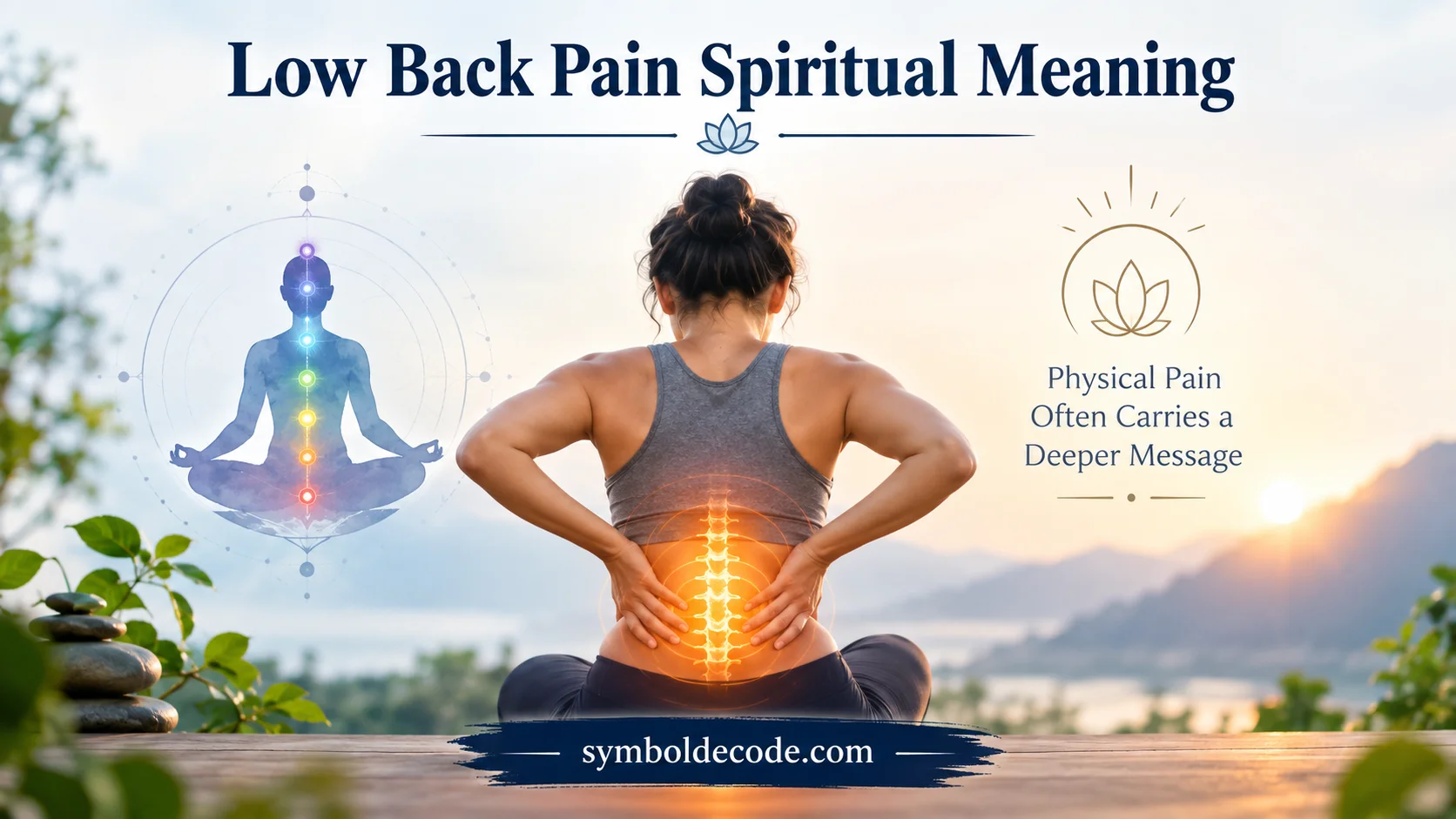
Low Back Pain Spiritual Meaning may connect lower back pain with emotional stress, personal struggles, and the way your body responds to physical issues. When pain becomes debilitating, it can create desperation and make you search for relief. The lower back, including the lumbar spine and sacrum, is sometimes viewed as a storehouse for emotion. Exploring deeper emotional roots and psychological roots may help you understand your back pain while listening to your body and supporting your efforts to heal.
With chronic back pain, the spiritual side can be overlooked, especially when people have tried everything else and remain desperate for answers. Jeana Naluai, Director of Ho’omana Spa on the island of Maui, and a kumu or teacher of indigenous Hawaiian wisdom and practices, has discussed back pain as a common complaint. If your lower back aches, stretching and rest may not explain why the pain keeps coming back. Spiritual meanings, emotional meanings, and 7 spiritual signs may offer a personal message or guide, including the root chakra, its connection, and ideas about stability, support, the Bible, and burden.
Quick Answer
Low Back Pain Spiritual Meaning is commonly associated with feeling unsupported, insecure, overburdened, ungrounded, or afraid of change. In the USA, these ideas often appear in modern wellness and self-reflection, while broader spiritual traditions may connect the lower back with grounding, stability, and the foundation of life.
TL;DR
- Low back pain is often symbolically linked with support and stability.
- Spiritual interpretations may focus on security, responsibility, fear, or grounding.
- The sacrum has an old association with sacredness in Western history.
- Modern wellness connects the lower body with grounding and emotional balance.
- Spiritual symbolism does not establish the physical cause of pain.
- Reflection can complement, but should not replace, appropriate health care.
What Does Low Back Pain Symbolize Spiritually?
The Foundation of the Body
The lower back sits near the center of the body’s physical foundation. Symbolically, that makes it easy to associate this area with the foundations of life.
In spiritual writing, pain in this region is sometimes interpreted as a reminder to examine what supports you. That might include family, work, finances, relationships, routines, or personal beliefs.
Common symbolic themes include:
- Feeling unsupported by people around you
- Carrying too much responsibility alone
- Worrying about safety or stability
- Struggling to feel grounded during change
- Needing stronger emotional or personal boundaries
- Holding onto situations that create constant pressure
These ideas are interpretations, not universal rules. One person may see discomfort as an invitation for reflection, while another may simply experience a physical condition.
The Spiritual Meaning of Lower Back Pain
Support and Stability
A common spiritual interpretation connects the lower back with support. Because the back physically helps support the body, it can become a metaphor for the support systems in everyday life.
For example, someone going through a difficult job change might wonder whether they feel secure. Another person might be caring for family members while receiving little help themselves.
This symbolic approach asks a simple question: Where in my life do I need more support?
Security and Uncertainty
Another interpretation centers on security. Changes involving money, housing, work, relationships, or family can create uncertainty.
Some spiritual traditions and modern wellness writers therefore connect lower-back discomfort with concerns about survival, stability, or material security. However, this doesn’t mean financial worry directly causes every episode of back pain.
Low Back Pain and Feeling Unsupported
Emotional Support
Feeling unsupported can affect how people understand physical discomfort. The lower back becomes a natural symbol because it literally helps carry the body.
Someone might reflect on whether they are always helping others while rarely accepting help themselves. Another person may recognize that they have been trying to solve every problem alone.
The symbolism can therefore point toward balance rather than blame. Instead of asking, “Why did I cause this?” a gentler question is, “Where could I allow more support into my life?”
Responsibility and Burden
The phrase “carrying the weight of the world” is familiar in American culture. Although it isn’t a medical explanation for back pain, it illustrates why the back often becomes a metaphor for burdens.
Symbolically, low back discomfort may represent:
- Too many obligations at once
- Difficulty saying no to others
- Pressure to remain strong
- Fear of disappointing people
- Taking responsibility for problems you can’t control
The useful part of this interpretation is self-reflection. It shouldn’t become a reason to blame yourself for pain.
Low Back Pain, Grounding, and Security
What Grounding Represents
Grounding is a popular concept in modern spiritual and wellness communities. It generally describes feeling present, stable, connected, and settled rather than mentally scattered.
Because the lower back sits close to the pelvis and legs, some symbolic systems associate it with grounding. The imagery is straightforward: your upper body moves through life while your lower body provides stability.
Grounding may therefore symbolize:
- Feeling connected to your present circumstances
- Creating dependable daily routines
- Spending time in nature
- Building emotional steadiness
- Accepting change without losing your sense of self
These practices can have personal meaning without requiring a supernatural explanation.
The Sacrum and Ancient Spiritual Symbolism
Why the Sacrum Is Called “Sacred”
The sacrum is a triangular bone at the base of the spine. Its name is related to an ancient Latin expression meaning “sacred bone,” reflecting an old association between this part of the body and sacred significance.
Ancient Greek medical and anatomical traditions also used language describing the sacrum as a sacred bone. The reasons behind the name are not completely certain, and modern interpretations sometimes give the history more certainty than the evidence allows.
Still, the historical association is interesting. It shows that the lower part of the spine has carried symbolic importance for centuries.
From Ancient Ideas to Modern Wellness
Ancient body symbolism was often connected with religion, anatomy, death, fertility, and ideas about the soul. Modern wellness language tends to frame the same region through concepts such as grounding, energy, emotional release, and stability.
These aren’t identical traditions. Modern interpretations should not automatically be presented as ancient beliefs.
What Does Low Back Pain Mean in the USA?
American Ideas of Strength and Responsibility
In the United States, back symbolism often overlaps with cultural ideas about independence. People are frequently encouraged to handle responsibilities, work hard, provide for others, and remain self-reliant.
Because of this, lower-back symbolism can feel especially relatable when someone is overwhelmed by responsibilities.
A person may connect the area with questions such as:
- Am I doing too much for everyone else?
- Do I feel financially or emotionally secure?
- Am I comfortable asking for help?
- Have my responsibilities become overwhelming?
- Do I have enough time to recover and rest?
These questions reflect cultural patterns rather than a fixed American spiritual doctrine.
Everyday American Symbolism
The lower back can also symbolize the foundation beneath ordinary life. Home, family, employment, savings, relationships, and personal routines all contribute to a sense of stability.
That makes lower-back symbolism particularly relevant during major life transitions. Moving, changing jobs, becoming a parent, ending a relationship, or starting over can all invite reflection about stability.
Low Back Pain and Emotional Stress
The Mind-Body Connection
Modern research supports the idea that stress and emotional distress can influence the experience of pain. Chronic stress can contribute to muscle tension, poor sleep, and changes in how the nervous system processes discomfort.
This is different from saying that emotional problems are the hidden cause of every physical symptom. Low back pain can have structural, mechanical, inflammatory, neurological, or other causes.
Mind-body approaches such as mindfulness, relaxation, yoga, and similar practices have been studied for low-back pain, with evidence varying by approach and condition.
Emotional Themes People May Explore
When people search for spiritual meaning, they often focus on emotions that feel difficult to express.
Possible themes include:
- Fear about the future
- Feeling emotionally exhausted
- Frustration with responsibilities
- Difficulty releasing resentment
- Feeling trapped by circumstances
- Anxiety about personal security
These themes can be useful prompts for reflection. They aren’t diagnostic signs.
Low Back Pain and the Root Chakra
A Modern Spiritual Interpretation
In some modern chakra-based practices, the lower body is associated with the root chakra, commonly called Muladhara. It is traditionally represented in those systems with themes such as grounding, survival, stability, and connection to the physical world.
Because the lower back is located near this region, modern spiritual writers sometimes connect lower-back discomfort with root-chakra themes.
However, chakra interpretations vary across traditions and modern schools. They shouldn’t be treated as a single universal belief shared by all Hindu or Buddhist traditions.
Common Symbolic Themes
Within modern chakra-based wellness language, people may explore:
- Grounding
- Safety
- Stability
- Belonging
- Physical presence
- Confidence about basic needs
For someone who finds this framework meaningful, these ideas can provide a language for personal reflection.
Low Back Pain and Fear of the Future
Security and Change
Lower-back symbolism is sometimes associated with fear because stability can feel threatened during uncertain periods. A new job, financial pressure, family conflict, or major move can challenge a person’s sense of security.
This interpretation doesn’t claim that fear physically creates pain. Instead, it treats discomfort as a prompt to examine how someone feels about change.
The deeper question may be less about predicting the future and more about identifying what feels uncertain right now.
Building Inner Stability
Symbolically, stability doesn’t always mean keeping everything unchanged. Sometimes it means developing enough flexibility to handle change.
That can involve creating routines, asking for help, setting boundaries, or making time for rest. These are practical choices that can also carry personal spiritual meaning.
Low Back Pain and Letting Go
Releasing Emotional Weight
Some spiritual interpretations describe pain as a metaphor for holding onto emotional weight. The idea of “letting go” appears in many modern wellness conversations.
That doesn’t mean someone should assume an unresolved emotion caused their pain. Instead, letting go can be understood as a reflective practice.
You might ask whether you’re still carrying an old argument, unrealistic expectation, guilt, or responsibility that no longer belongs to you.
Acceptance Without Self-Blame
Healthy spiritual reflection should create compassion rather than guilt. If someone experiences pain, telling them that they “created” it through negative thinking can be harmful and misleading.
A more balanced approach is to consider emotional and spiritual questions alongside the physical reality of the symptom.
Read More: Spiritual Meaning of Broken Window
Low Back Pain Across Cultures and Spiritual Traditions
Shared Themes
Different cultures have developed different ideas about the relationship between body, emotion, spirit, and wellbeing. Yet certain themes appear repeatedly in modern interpretations.
Support, grounding, strength, balance, and connection are common symbolic ideas.
| Context | Symbolic Meaning | Common Association | Important Note |
| Modern American wellness | Support and stability | Stress, responsibility, grounding | Not a medical explanation |
| Chakra-based wellness | Grounding and security | Root chakra themes | Interpretations vary |
| Ancient Western symbolism | Sacred significance | Sacrum or “sacred bone” | Historical meaning has uncertainty |
| Mind-body practices | Awareness and balance | Mindfulness, relaxation, movement | Studied separately from spiritual claims |
| Personal reflection | Emotional burden | Boundaries and support | Highly individual |
Respecting Cultural Differences
Spiritual symbolism should not be presented as though every culture teaches the same thing. Some modern websites blend ideas from several traditions and describe them as ancient universal truths.
A better approach is to identify the tradition and recognize that beliefs change over time. This keeps spiritual discussion respectful and avoids turning complex traditions into simple formulas.
Low Back Pain in Tattoos, Social Media, and Modern Wellness
Tattoos and Personal Symbolism
People sometimes use body imagery to represent healing, strength, grounding, or personal transformation. Lower-back tattoos can therefore carry private meanings connected with survival, recovery, or a new chapter.
However, the location itself doesn’t guarantee a particular meaning. Tattoo symbolism is personal, and the same image can represent completely different experiences.
Social Media and Wellness Culture
On social media, spiritual explanations for physical symptoms are easy to share because they offer simple narratives. A post may claim that one body area always represents one emotion or life problem.
Those claims should be viewed carefully. Symbolism can be meaningful without being universal, scientific, or predictive.
Misunderstandings About the Spiritual Meaning of Low Back Pain
Symbolism Is Not a Diagnosis
One of the biggest misunderstandings is treating spiritual symbolism as a medical diagnosis. A person may experience low back pain because of muscle strain, disc problems, nerve irritation, injury, aging, inflammation, or other causes.
In many cases, the exact cause isn’t immediately obvious. Spiritual reflection can coexist with medical understanding, but it shouldn’t replace it.
Avoiding Spiritual Blame
Another harmful idea is that pain proves someone has negative thoughts or unresolved emotions. That approach can create unnecessary guilt.
A more compassionate interpretation is that pain can inspire reflection without assigning fault. Your physical discomfort doesn’t mean you’ve failed spiritually.
How the Meaning of Low Back Pain Has Changed
From Sacred Anatomy to Modern Self-Reflection
The history of the sacrum shows that people have long attached special meaning to the lower spine. Yet the meanings have changed considerably.
Older traditions often connected the body with sacred anatomy, religion, reproduction, death, and the soul. Modern wellness discussions more often emphasize grounding, emotional balance, security, and personal growth.
What Has Stayed the Same?
One theme remains surprisingly consistent: the lower back is associated with the body’s foundation.
Today, that foundation is often used metaphorically. It can represent the support systems, beliefs, relationships, and routines that help a person feel steady.
How to Reflect on the Spiritual Meaning Safely
Questions for Personal Reflection
If you’re exploring symbolism, you don’t need to accept any interpretation as fact. Instead, use the ideas as questions that may help you understand your current circumstances.
Consider asking:
- Where do I currently feel unsupported?
- What responsibility feels heavier than it should?
- Do I feel secure in my daily life?
- What change am I resisting?
- Where could I ask for appropriate help?
- What helps me feel grounded and present?
These questions are about self-awareness, not diagnosing the cause of pain.
When Physical Symptoms Need Attention
Persistent or severe back pain deserves appropriate medical attention. Medical sources recommend seeking care for concerning symptoms such as significant weakness, numbness, trouble urinating, fever, unexplained weight loss, or pain following an injury.
Spiritual reflection can remain part of someone’s personal experience while physical symptoms are evaluated properly.
FAQs:
Is There a Spiritual Meaning Behind Low Back Pain?
Some spiritual and wellness traditions associate low back pain with support, security, grounding, responsibility, or emotional burdens. These are symbolic interpretations rather than established medical causes.
What Does Lower Back Pain Mean Emotionally?
Some people connect it with stress, feeling unsupported, fear about stability, or carrying too many responsibilities. However, emotional interpretations vary, and physical causes should not be overlooked.
Does Low Back Pain Mean I Am Not Grounded?
In modern spiritual language, the lower body is sometimes associated with grounding and stability. Feeling ungrounded can therefore become a useful reflection theme, but pain itself doesn’t prove that you lack grounding.
What Does the Sacrum Symbolize Spiritually?
The sacrum has an old association with sacredness, reflected in its historical name. Modern spiritual practices may also connect the area with grounding, stability, and foundational energy.
Can Stress Affect Low Back Pain?
Yes, stress and emotional distress can influence how pain is experienced and may contribute to muscle tension and other factors. This doesn’t mean stress is responsible for every case of low back pain.
Should I Treat Spiritual Meaning Instead of Physical Causes?
No. Spiritual reflection and appropriate health care don’t have to compete. If pain is persistent, severe, follows an injury, or occurs with concerning symptoms, professional medical evaluation is important.
Conclusion:
The Low Back Pain Spiritual Meaning is often explored through themes of support, security, grounding, responsibility, and emotional weight. These ideas can offer a meaningful way to reflect on your life, especially during stressful transitions or periods of uncertainty. At the same time, symbolism shouldn’t turn physical pain into a source of guilt or replace medical understanding. If the lower back is hurting, you can care for both sides of the experience: pay attention to your body while gently considering what your life may be asking you to examine.