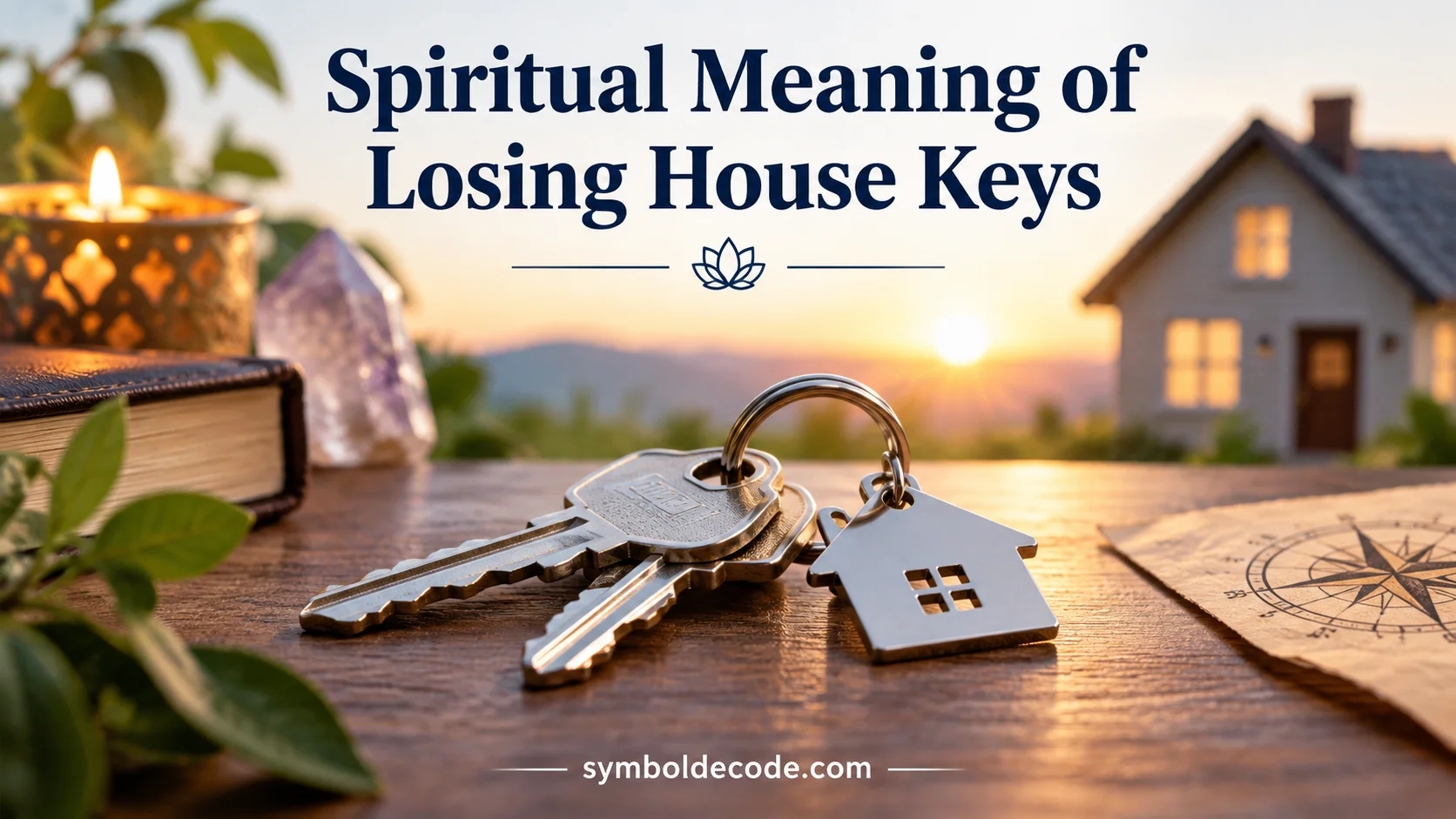
The Spiritual Meaning of Losing House Keys can suggest spiritual significance during a moment of transition. Throughout history and ancient times, keys have represented sacred knowledge, transformation, divine mysteries, and the universe. A potent symbol like a lost key may reflect something important in your waking life. Feeling disoriented can show that access to opportunities, understanding, or certain aspects of your life feels temporarily out of reach, encouraging an internal quest for clarity and direction.
A dream about losing keys may connect with personal identity, your capacity to unlock new parts of yourself, secure your personal space, and find solutions to life’s challenges. Across cultures, keys have symbolized power, initiation, and knowledge. The symbolism of keys in art often connects them with what is hidden. Keys can open doors to new dimensions, both physical and spiritual, helping reveal what was once invisible. To hold a key represents the means to enter, understand, or transform something.
Quick Answer
The Spiritual Meaning of Losing House Keys can symbolize feeling temporarily disconnected from security, belonging, control, or an important part of your life. In a broader spiritual sense, it may represent a transition, a blocked path, or a reminder to reconsider which boundaries and priorities matter most.
TL;DR
- Losing house keys can symbolize disrupted security or personal control.
- Keys traditionally represent access, authority, protection, and responsibility.
- A lost key may reflect a period of change or uncertainty.
- In America, house keys strongly connect with independence and privacy.
- Spiritually, the experience can encourage reflection rather than fear.
- The meaning depends on your circumstances and emotional response.
What Does Losing House Keys Symbolize?
Losing house keys has a strong symbolic connection with access. Your key allows you to cross the boundary between the outside world and your private home.
Because of that role, losing it can represent a temporary feeling of being unable to reach something important. For an American reader, this can relate to independence, family life, personal space, or a changing sense of home.
Access and Opportunity
A key normally gives you access to something protected. When it disappears, the symbolism naturally reverses.
It can suggest that an opportunity, answer, relationship, or personal goal feels temporarily out of reach. However, this does not mean the opportunity is permanently lost.
Security and Belonging
A house key also represents belonging. You carry it because you have permission to enter a particular place.
Therefore, losing it can symbolize questions such as:
- Where do I feel most secure?
- What currently makes me feel unsettled?
- Do I feel welcome in an important part of my life?
- What personal boundary needs more attention?
- Am I entering a new stage of life?
Historical Meaning of Keys and Locks
Keys have carried symbolic meaning for thousands of years because they control access. Ancient locks could be large and complicated, and some early keys were far larger than the compact keys people carry today.
Archaeological collections contain surviving Roman keys, including bronze examples from the first centuries of the Common Era. Historical evidence also shows that keys became powerful metaphors for authority and controlled passage.
Ancient Roots
In the ancient Mediterranean world, keys could represent access to protected spaces. Greek traditions connected keys with Hecate, a deity associated with crossroads and boundaries.
Roman traditions also connected keys with Janus, whose symbolism involved doorways, beginnings, endings, and transitions. These associations helped establish the key as an image of moving from one state to another.
Religious Development
Jewish and Christian scriptures also use key imagery. Biblical passages connect keys with authority, knowledge, and the ability to open or close.
Christian art later developed the familiar image of Saint Peter holding keys. This helped make the key a lasting symbol of spiritual authority and access in Western religious imagery.
Spiritual Meaning of Losing a House Key
Spiritually, losing a house key can be viewed as a symbol of temporary disconnection. The house represents a protected personal space, while the key represents your ability to enter it.
This combination can encourage reflection about where you currently feel secure or uncertain. It doesn’t necessarily mean that something bad is coming.
A Period of Transition
Keys open doors, and doors often represent change. Therefore, losing a key can become a meaningful image during major life transitions.
You might experience this symbolism during a move, career change, relationship shift, family transition, or period of personal growth.
A Reminder to Pause
Sometimes the most useful interpretation is simply to slow down. Losing something essential forces you to stop, retrace your steps, and pay attention.
That experience can become a reminder to examine your routines, priorities, and direction before moving forward.
What Does Losing House Keys Mean in America?
In the United States, a house key often carries strong associations with independence. Getting your first apartment key, buying a home, or receiving a family key can represent adulthood and personal responsibility.
That cultural meaning makes a lost house key emotionally powerful. It can feel like losing temporary control over a space that represents safety and independence.
The American Home
American culture often places strong value on having a private home. The home can represent family, stability, freedom, privacy, and personal achievement.
As a result, losing the key can symbolically touch several of these ideas at once.
| Context | Meaning in the USA | Common Association | Symbolic Theme |
| First home key | Independence | Adulthood | Personal freedom |
| Family house key | Belonging | Trust | Connection |
| Lost key | Temporary disruption | Stress | Access |
| Old house key | Past connection | Memories | Transition |
| New house key | Fresh beginning | Moving | Opportunity |
Privacy and Personal Boundaries
A house key also protects private space. It determines who can enter and who must remain outside.
Therefore, losing your key may encourage you to think about emotional boundaries. You might ask whether someone has too much access to your time, energy, or personal life.
Losing House Keys and Personal Security
Security is one of the clearest symbolic meanings connected with house keys. The key lets you close your home and control access to your private environment.
When the key disappears, that sense of control can temporarily weaken. The emotional reaction may reveal how strongly you connect security with physical surroundings.
Feeling Unprotected
A lost key can produce an immediate feeling of vulnerability. You may worry about who could find it or whether your home remains secure.
Symbolically, that reaction can mirror emotional concerns about trust, privacy, or protection.
Rebuilding Security
The practical solution to a lost key is usually straightforward. You retrace your steps, contact someone who can help, or replace the lock if necessary.
Symbolically, this process can represent rebuilding security after uncertainty. The experience may remind you that security can be restored through practical action.
Losing House Keys and Life Transitions
Keys are naturally connected with thresholds. A threshold is a point where you move from one space or stage into another.
Because of this, a lost house key can feel especially meaningful during periods when your life is changing.
Moving to a New Home
Moving can bring excitement and uncertainty at the same time. Your old home may represent familiarity, while the new one represents possibility.
Losing a key during this period may reflect the emotional tension between letting go and beginning again.
Changing Roles
Life transitions don’t always involve moving. Marriage, parenthood, retirement, a new career, or leaving school can also change your identity.
In those situations, a lost key may symbolically represent uncertainty about how to enter your new role.
Emotional Meaning of Losing House Keys
The emotional reaction matters as much as the object itself. Someone who feels calm may interpret the event differently from someone who experiences intense panic.
Your first emotional response can provide useful clues about the symbolism.
If You Feel Panicked
Panic may reflect concerns about control, deadlines, responsibilities, or personal security. The key becomes a symbol of something you believe you must recover quickly.
This doesn’t mean the event predicts trouble. Instead, it may mirror pressure already present in your daily life.
If You Feel Relieved
Interestingly, losing a key doesn’t always symbolize something negative. If you feel strangely relieved, the experience may connect with wanting freedom from an old responsibility.
You may be ready to leave behind a role, routine, relationship, or expectation that no longer feels right.
Psychological Meaning of Losing House Keys
There is also a simple psychological explanation. People frequently misplace objects when they are distracted, tired, rushed, or managing several tasks.
Therefore, losing your keys doesn’t automatically carry a spiritual message.
Stress and Attention
Keys are often handled automatically. You may put them somewhere without consciously noticing.
During stressful periods, attention can become scattered. A lost key may simply be evidence that your mind was focused elsewhere.
Symbolic Reflection
At the same time, an ordinary event can become personally meaningful. If losing your keys happens during a major life change, you may naturally connect the experience with that transition.
The useful approach is to treat symbolism as reflection rather than certainty.
Cross-Cultural and Spiritual Meanings of Keys
Key symbolism appears in several religious and cultural traditions. However, each tradition has its own history, and meanings should not be treated as interchangeable.
In Christian traditions, keys can represent authority and spiritual access. In ancient Greek traditions, Hecate’s association with boundaries and crossroads gives the key a different but related theme of passage.
Christian Symbolism
Christian imagery often uses keys to represent authority, stewardship, and access. The familiar image of Saint Peter with keys comes from New Testament passages concerning the keys of the kingdom.
Therefore, losing a key can be interpreted within this tradition as an image of feeling separated from access or responsibility. It remains an interpretation, not a universal religious teaching.
Ancient Greek and Roman Symbolism
Hecate was associated with crossroads and pathways, while Roman Janus represented doorways and transitions.
These traditions make the key especially suitable as a symbol of change. Losing one can therefore be read as an image of uncertainty at a threshold.
Broader Spiritual Themes
Across symbolic traditions, keys commonly connect with:
- Access to something protected or unknown.
- Responsibility for a place or role.
- Movement across an important boundary.
- Protection of private or sacred spaces.
- Discovery of knowledge or new possibilit
Read More: Spiritual Meaning of Magpie Tapping on Window
What Does It Mean to Dream About Losing House Keys?
Dreams about losing house keys often intensify the same themes found in waking symbolism. The house may represent familiarity, identity, privacy, or emotional security.
However, dream meanings are not universal formulas. The setting and your feelings matter greatly.
Searching Everywhere for the Key
Searching frantically may reflect frustration about something you can’t currently resolve. The dream could mirror concerns about responsibilities, relationships, work, or personal direction.
If you eventually find the key, the ending may feel especially important. Finding it can represent renewed confidence or a solution becoming visible.
Losing the Key Outside Your Home
A key lost outside can emphasize separation from safety or familiarity. You may feel caught between an old situation and a new one.
This interpretation can fit periods when you’re adapting to unfamiliar circumstances.
Finding the Key Again
Finding the key often creates a sense of relief. Symbolically, that moment can represent restored access, confidence, belonging, or clarity.
It may also simply reflect your mind completing a stressful problem.
Modern Uses of Key Symbolism
Keys remain popular symbolic objects because their meaning is easy to understand. A key can communicate opening, freedom, secrecy, trust, protection, and personal history without many words.
Today, key imagery appears in jewelry, tattoos, artwork, home decor, social media posts, and personal gifts.
Tattoos and Jewelry
A key tattoo may represent independence, a major life chapter, a relationship, or access to personal potential.
Some people pair keys with locks, doors, hearts, dates, initials, or other personal imagery. The meaning depends heavily on the individual.
Home Decor and Gifts
Decorative keys can create a vintage or nostalgic feeling. Antique-style keys may suggest history, mystery, family heritage, or hidden stories.
Key-shaped gifts can also symbolize trust. Giving someone a key has long carried an emotional meaning because it grants access to a private space.
Misunderstandings About Losing House Keys
A common misunderstanding is that losing a house key automatically signals bad luck. There is no universal spiritual rule that makes a lost key an omen of misfortune.
Instead, different traditions and modern symbolic interpretations emphasize different themes.
Symbolism Is Not Prediction
A symbolic interpretation can help you reflect on your feelings. It cannot reliably predict a specific event.
For example, losing a key might remind you to examine your sense of security. It doesn’t establish that you will lose your home, experience a breakup, or face another specific event.
Avoiding Fear-Based Interpretations
Some online interpretations treat ordinary experiences as warnings of unavoidable events. That approach can make a simple mistake feel frightening.
A calmer approach is to ask what the experience brings to mind. Reflection is more useful than assuming a fixed outcome.
How the Meaning of Lost Keys Has Changed
The basic symbolism of keys has remained surprisingly consistent. Keys still control access, protect spaces, and indicate responsibility.
However, the context has changed dramatically. Ancient keys could control temples, storage areas, gates, or important rooms, while today’s house key usually controls access to a private residence.
From Authority to Independence
Historically, holding a key could indicate authority over a household or protected space. Today, carrying your own house key often represents personal independence.
That shift is especially meaningful in American culture, where having your own home or apartment can represent adulthood and autonomy.
From Physical Objects to Digital Access
Modern technology is also changing the meaning of access. Many homes now use electronic locks, keypad systems, phone-based entry, or smart-home devices.
Even so, the underlying symbolism remains familiar. Whether you carry a metal key or use a phone, access still represents security and permission.
What Should You Reflect on After Losing Your House Keys?
A lost key can become a useful moment for personal reflection without requiring a supernatural explanation. The most meaningful question is often what was happening in your life when you lost it.
Questions to Consider
You might reflect on these simple questions:
- Where do I currently feel secure?
- What part of life feels difficult to access?
- Am I entering or leaving an important stage?
- Do I need stronger personal boundaries?
- What responsibility feels heavy right now?
- Is there something familiar that I’m ready to release?
Turning the Experience Into Reflection
Instead of treating the lost key as a warning, consider it a prompt. It can encourage you to pause and notice what has been changing around you.
Sometimes the meaning isn’t hidden in the object itself. It comes from the feelings and circumstances surrounding the experience.
FAQs:
What does losing house keys mean spiritually?
Losing house keys can symbolize disrupted security, access, control, or belonging. Spiritually, some people interpret it as a reminder to examine boundaries or prepare for change.
Is losing a house key a bad omen?
There is no universal spiritual tradition saying that losing a house key guarantees bad luck. It can be understood symbolically as uncertainty, transition, or temporary loss of access.
What does losing keys mean in a dream?
A dream about losing keys may reflect concerns about security, responsibility, belonging, or access. The dream’s setting and your emotional response can change the interpretation.
What does finding lost house keys symbolize?
Finding lost keys can symbolize restored access, relief, confidence, or renewed direction. It may also simply represent the resolution of a stressful situation.
What do keys symbolize spiritually?
Keys are commonly associated with access, authority, protection, knowledge, responsibility, and transitions. Different cultures and religions give these ideas their own meanings.
What does losing house keys mean during a life change?
During a transition, losing house keys may symbolize uncertainty about your next stage. It can also represent the emotional process of leaving something familiar behind.
Conclusion:
The Spiritual Meaning of Losing House Keys often centers on security, access, boundaries, independence, and transition. Because a house key connects you directly with your private space, losing it can naturally raise questions about where you feel safe and where you belong. Historically, keys have represented more than physical entry, connecting with authority, protected spaces, knowledge, and thresholds. Today, their symbolism continues through homes, relationships, jewelry, tattoos, dreams, and personal reflection. If you lose your house keys, you don’t need to assume something bad is coming. Instead, use the moment as a gentle reminder to check what feels secure, what is changing, and which doors you genuinely want to open next.