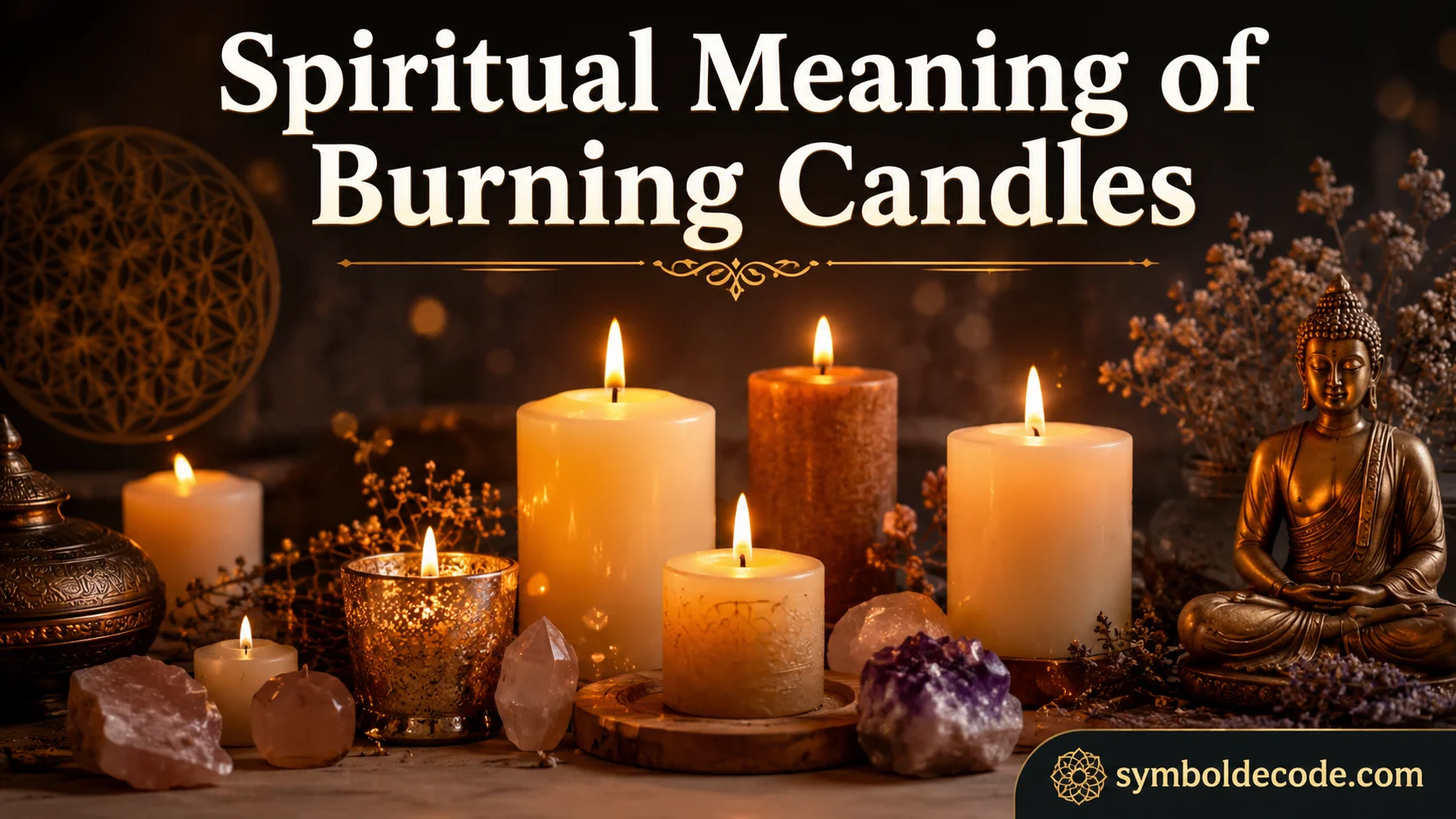
The Spiritual Meaning of Burning Candles is often linked with spiritual awareness, Light, reflection, and inner change. A burning candle can create a peaceful space for meditation, prayer, and personal reflection. Its candle scent, such as vanilla, cinnamon, or lavender, may affect the senses and create a calming experience. For some people, candle burning may symbolize spiritual messages, energy, transformation, inner illumination, and a deeper spiritual path during quiet moments of contemplation and healing.
Candles also carry different meanings through their colors and spiritual uses. A pink candle may represent love, while a turquoise candle can symbolize prosperity, abundance, and positive energy. Lighting candles during a meditation practice may support the meditative process and encourage connection with the Divine Light. The gentle flame can also symbolize conscious awareness, spiritual healing, personal growth, and transformation. Many people use candles during ritual, prayers, contemplation, and other sacred activities.
Quick Answer
The Spiritual Meaning of Burning Candles in the USA commonly symbolizes hope, prayer, remembrance, guidance, peace, and intention. More broadly, the flame represents light overcoming darkness and the human desire to connect with something meaningful.
TL;DR
- Candles commonly symbolize light, hope, prayer, and remembrance.
- Ancient cultures connected fire with sacred presence and ritual.
- American traditions use candles for worship, holidays, memorials, and reflection.
- White often suggests peace, while other colors vary by tradition.
- A burning flame can represent transformation, focus, or spiritual awareness.
- Modern candle rituals often combine symbolism with mindfulness and personal intention.
What Does a Burning Candle Symbolize?
A burning candle is a simple object with layers of meaning. Its small flame creates light without filling an entire room, which makes it a natural symbol for hope during difficult periods.
For American readers, the meaning often depends on where and why the candle appears. A candle at a memorial feels different from one on a birthday cake.
Light in Darkness
The most common meaning is light in darkness. The flame can represent guidance, clarity, hope, or the search for understanding.
Because darkness often represents uncertainty, the flame becomes a visual reminder that even a small source of light can change an environment.
Common Symbolic Meanings
People may associate a burning candle with:
- Hope during uncertain or difficult times
- Prayer and spiritual devotion
- Remembrance of someone who has died
- Peace during quiet reflection
- Guidance when facing an important decision
- Transformation because the flame changes wax into light
These meanings overlap, but they aren’t rules. Personal experience often shapes what the flame means to an individual.
Ancient Roots of Candle and Fire Symbolism
Candle symbolism developed from much older traditions involving fire and light. Before modern candles existed, people already treated fire as an important part of human life and ritual.
Historical evidence shows that candle-like lighting existed in ancient civilizations, while ceremonial light developed across many religious traditions. The candle later became a convenient way to preserve some of those older associations.
Fire Before Candles
Fire provided warmth, protection, cooking, and illumination. Yet it also inspired wonder because humans could create and control something bright and powerful.
In many ancient societies, flames became connected with offerings, ceremonies, sacred spaces, and communication with divine forces.
From Practical Light to Sacred Symbol
Over time, light gained symbolic meanings beyond its practical purpose. It could represent life, knowledge, purity, divine presence, or victory over darkness.
The modern candle inherited many of these ideas. However, it’s important not to assume that every ancient culture gave candles the same meaning.
Candle Symbolism in American Culture
In the United States, candles appear in both religious and secular settings. Their meanings have also been shaped by American holidays, memorial traditions, family customs, and popular culture.
Religious and Community Traditions
Candles are common in Christian worship and ceremonies. They may accompany prayer, worship services, Christmas traditions, Easter observances, weddings, and remembrance.
Jewish American communities also use candles in important traditions, including Sabbath and holiday observances. However, specific practices vary between communities and denominations.
Memorials and Public Grief
One of the strongest American associations is the memorial candle. People may light candles after a death, tragedy, disaster, or public loss.
The flame becomes a quiet way to say that someone is remembered. It can also create a shared moment of reflection when words feel inadequate.
A Familiar American Symbol
| Context | Meaning in the USA | Common Associations | Notes |
| Memorial | Remembrance and honor | Grief, memory, tribute | Often placed at vigils |
| Church | Prayer and sacred light | Faith, worship, devotion | Practices differ by denomination |
| Holidays | Celebration and tradition | Christmas, Hanukkah, birthdays | Meaning depends on the holiday |
| Home | Calm and reflection | Comfort, relaxation, atmosphere | Often secular |
| Personal ritual | Intention and focus | Meditation, reflection, goals | Highly individual |
Spiritual Meaning of Candle Colors
Candle color can add another symbolic layer. However, color meanings are not universal, and they often come from particular religious, spiritual, or folk traditions.
A white candle, for example, is frequently associated with purity, peace, clarity, or prayer. Other colors may carry different meanings depending on the practice.
Common Modern Associations
In contemporary spiritual practices, people often interpret colors in ways such as:
- White: Peace, purity, clarity, and spiritual reflection
- Red: Passion, courage, energy, and strong emotion
- Blue: Calm, wisdom, peace, and communication
- Green: Growth, renewal, nature, and abundance
- Purple: Spirituality, reflection, wisdom, and transformation
- Yellow: Optimism, attention, confidence, and mental clarity
These associations should be viewed as symbolic conventions rather than universal spiritual laws.
Spiritual Meaning of a Candle Flame
The flame itself can feel more meaningful than the candle. It moves, changes shape, brightens, and sometimes becomes almost completely still.
That movement naturally encourages people to think about change and the temporary nature of life.
A Steady Flame
A steady flame is often interpreted symbolically as stability, peace, focus, or confidence. In meditation, watching a steady flame can also provide a simple point of attention.
However, a steady flame doesn’t automatically prove that a spiritual message is present. Air movement, wick condition, and wax can affect how a flame behaves.
A Flickering Flame
A flickering flame may be interpreted spiritually as movement, emotional energy, change, or heightened awareness.
From a practical viewpoint, flickering can result from drafts, airflow, wick size, or other physical conditions. Symbolic interpretations are personal rather than scientifically established signs.
Spiritual Meaning of Burning Candles in Prayer
For many people, lighting a candle during prayer gives a physical form to an inward intention. The flame can represent devotion, hope, remembrance, or a request for guidance.
In Christian traditions, candlelight has long been associated with sacred light and prayer. Similar uses of candles for religious observance appear in other faith traditions, though their meanings and practices differ.
Prayer and Presence
A candle can help mark the beginning of a prayerful moment. Its light creates a visible reminder to slow down and focus.
For someone praying for another person, the candle may also represent care and remembrance.
Prayer Without a Fixed Interpretation
Not everyone who lights a candle believes it carries supernatural power. Some people simply use the act to create a quiet environment for prayer.
That distinction matters because candle rituals can be meaningful without requiring everyone to interpret them in exactly the same way.
Read More: Dangers of Sleeping With Window Open Spiritual Meaning
Burning Candles and Remembrance
A candle is one of the most recognizable symbols of remembrance. Its small flame can represent a life that continues to matter through memory.
In American communities, candlelight vigils are often held after deaths, tragedies, or other painful events.
Honoring Someone Who Has Died
Lighting a candle can provide a simple ritual for grief. The act creates a moment where people can pause, remember, and express emotions.
In some Jewish traditions, memorial candles have specific religious significance. Christian communities also have longstanding traditions involving candles and remembrance.
Why the Symbol Feels Powerful
The candle burns for a limited time. That temporary nature can remind people of human mortality.
At the same time, its light suggests continuity. The person may be gone, but their memory, influence, and relationships remain.
Emotional and Psychological Meaning of Candlelight
Candlelight often creates a different emotional atmosphere from bright overhead lighting. Its softer appearance can encourage quietness and reflection.
Modern candle rituals frequently overlap with mindfulness, meditation, journaling, and personal self-care.
Calm and Focus
Watching a flame gives the eyes a simple point of attention. For some people, this makes it easier to pause from everyday distractions.
The ritual itself can also become comforting. Repeating the same small action can create a familiar transition into prayer, rest, or reflection.
Symbolic Emotional Messages
A burning candle may emotionally signal:
- Safety after a stressful experience
- Comfort during grief or loneliness
- Clarity during periods of uncertainty
- Hope when circumstances feel difficult
- Connection during prayer or remembrance
- Renewal after a major personal change
These are emotional associations, not guaranteed psychological effects.
Burning Candles for Meditation and Intention
Candle meditation is a modern practice that combines an old symbol with focused attention. A person may sit quietly and observe the flame for several minutes.
The goal isn’t necessarily to find a supernatural message. Instead, the candle can serve as a visual anchor for awareness.
Setting an Intention
Some people light a candle while thinking about a personal intention. This might involve gratitude, forgiveness, personal growth, prayer, or a desire to release an old habit.
The candle then becomes a physical reminder of an internal goal.
A Simple Reflective Practice
You might sit quietly, breathe slowly, and observe the flame. Then, consider one question that matters to you.
For example, ask yourself what you want to understand, appreciate, release, or remember. The meaning comes from reflection rather than from the candle alone.
Modern Uses in Homes, Tattoos, and Social Media
Candle symbolism has moved well beyond formal religious settings. Today, candles appear in home decor, tattoos, photography, wellness spaces, social media posts, and personal celebrations.
Candles in Home Decor
A candle can make a room feel warm and intimate. As a result, people often associate candles with comfort, hospitality, relaxation, and personal space.
The symbolic meaning may be completely secular. A person can enjoy candlelight without assigning any religious meaning to it.
Candle Tattoos
A candle tattoo can represent remembrance, faith, hope, survival, or personal transformation.
Sometimes the design includes a flame, smoke, flowers, dates, names, or other symbols. The surrounding imagery often determines the tattoo’s specific meaning.
Social Media and Digital Culture
Candles are also common in online posts about grief, anniversaries, celebrations, spirituality, and reflection.
A single candle emoji or candle image can communicate remembrance without requiring a long explanation.
Cross-Cultural and Religious Meanings
Candle symbolism appears in many traditions, but it should never be treated as one worldwide belief system. Different religions and cultures developed their own practices and interpretations.
Christianity
Christian traditions commonly connect light with Christ, faith, prayer, and divine presence. Candles can appear during worship, ceremonies, memorials, and seasonal observances.
The exact use differs among Catholic, Orthodox, Protestant, and other Christian communities.
Judaism
Candle lighting has important roles in Jewish life, including Sabbath and festival observances. Memorial lights can also be used to honor deceased loved ones.
These practices have specific religious histories and should not be reduced to generic ideas about “energy.”
Other Traditions
Candles and ritual flames also appear in Buddhist, Hindu, folk, and contemporary spiritual settings.
The meaning can involve devotion, offering, purification, celebration, concentration, or sacred presence. Each tradition deserves to be understood within its own context.
Misunderstandings and Controversies
Because candles appear across many traditions, they can easily be misunderstood. A practice that feels sacred to one person may simply be decorative to another.
Candle Flame Superstitions
Some modern spiritual sources assign fixed meanings to every flame movement. For example, a sudden flicker may be described as a spiritual presence or message.
There is no universal evidence supporting those claims. Physical causes such as airflow and wick conditions can explain many changes.
Candle Magic and Personal Spirituality
Some contemporary spiritual practitioners use candles as part of manifestation or ritual practices. These practices vary widely and may draw from different historical traditions.
They should not be presented as identical to established religious candle practices. The two can have very different histories and beliefs.
Respecting Sacred Symbols
A candle may be decorative in one setting and deeply sacred in another. Context therefore matters.
When using religious symbols, respectful presentation helps avoid turning another tradition into a vague aesthetic trend.
How Candle Symbolism Has Changed Over Time
The meaning of burning candles has never remained completely fixed. Their role changed as technology, religion, culture, and everyday life changed.
Before electric lighting, candles were essential sources of illumination. Today, they are often optional objects used for atmosphere, ritual, memory, and personal expression.
From Necessity to Symbol
Electricity reduced the candle’s practical importance in American homes. However, that change arguably made its symbolic role more visible.
People now light candles because they want a certain feeling or meaning, not because they need the room illuminated.
A Symbol That Continues to Adapt
Modern Americans may use the same flame for very different purposes. One person may pray beside it, another may remember a loved one, and another may simply enjoy its warmth.
That flexibility helps explain why candle symbolism remains powerful today.
FAQs:
What Does It Mean When You See a Candle Burning?
A burning candle can symbolize hope, prayer, remembrance, peace, or personal intention. Its meaning depends strongly on the setting and the person’s beliefs.
What Does a Candle Represent Spiritually?
Spiritually, a candle often represents light, guidance, devotion, transformation, or connection. Different traditions may give the flame more specific meanings.
What Does a White Burning Candle Mean?
A white candle is commonly associated with peace, purity, clarity, and spiritual reflection. However, color symbolism varies between traditions and personal practices.
What Does It Mean When a Candle Flame Flickers?
A flickering flame may be interpreted symbolically as change, movement, or heightened awareness. Physically, drafts, airflow, wick condition, and wax can also cause flickering.
Why Do People Light Candles for the Dead?
Candles can provide a visible symbol of remembrance and continuing love. Memorial candle lighting is found in several religious and secular traditions.
Is Burning a Candle a Form of Prayer?
It can be, depending on the person’s religious practice and intention. For others, lighting a candle is simply a reflective or commemorative act.
Conclusion:
The Spiritual Meaning of Burning Candles centers on one enduring idea: light can represent hope in darkness. Across American life, candles can symbolize prayer, remembrance, peace, guidance, celebration, and personal reflection. Their history is older and broader than any single tradition, yet their meaning remains personal. A small flame may mark grief, faith, gratitude, a new beginning, or quiet reflection. The next time you light a candle, consider what the flame represents to you. Sometimes its greatest meaning comes not from a fixed interpretation, but from the intention you bring to the moment.