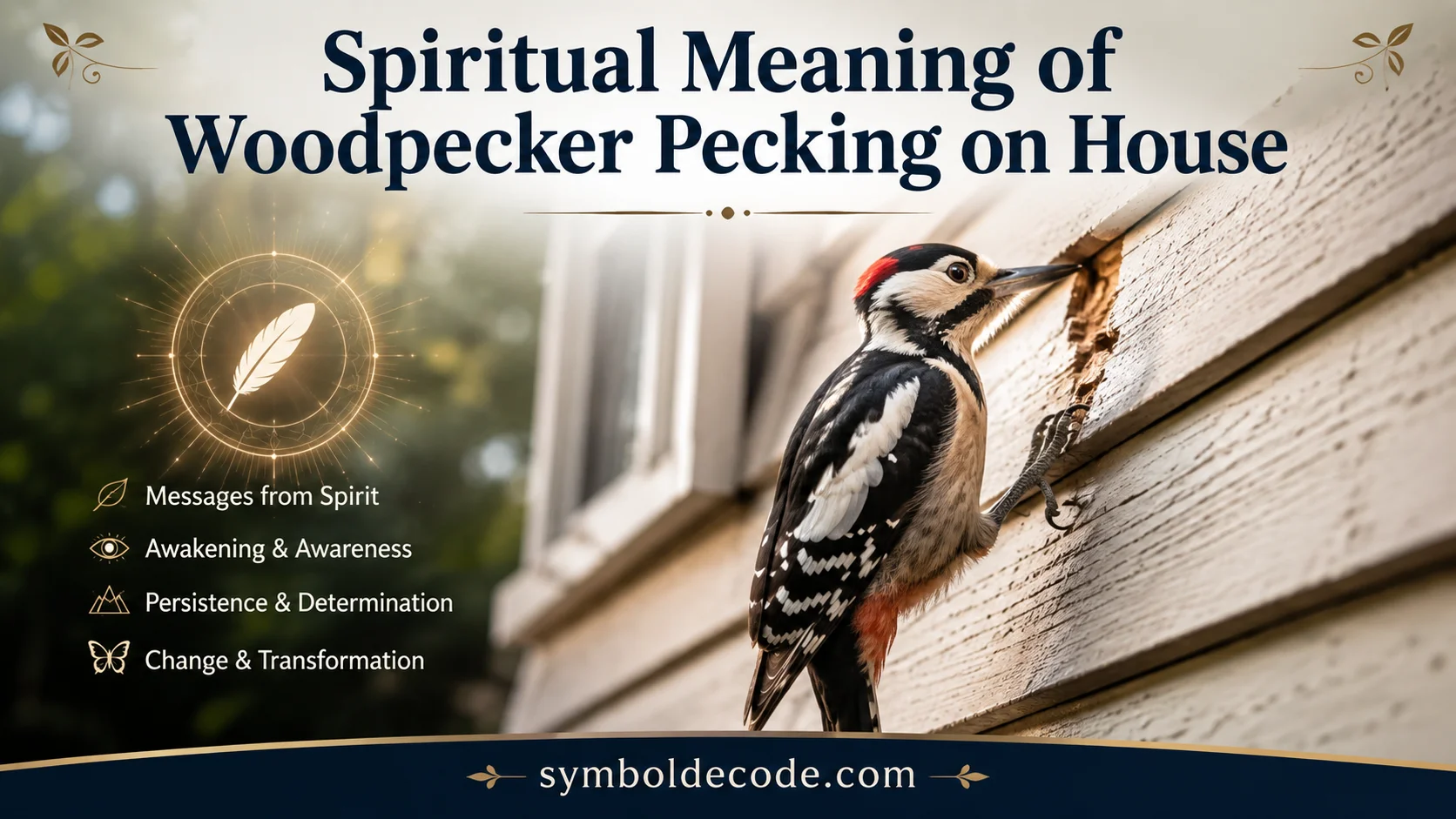
Spiritual Meaning of Woodpecker Pecking on House may suggest persistence, attention, and a new opportunity. When a woodpecker repeatedly taps your house, its rhythmic drumming can feel like a reminder to stay steady and determined. Symbolically, the bird may encourage you to keep tapping when a hidden door seems difficult to open. Its persistent behavior represents breaking through, noticing important changes, and staying aware of chances that may appear unexpectedly in your life.
A woodpecker can also symbolize renewal, transformation, and awareness. Its strong beak, focused movements, and repeated pecking show how patience can help you overcome challenges and hammer out solutions. In spiritual symbolism, seeing this amazing bird may encourage you to seize the moment, finish an old project, or begin something new. Its presence can also represent a breakthrough, a serendipitous meeting, or an opportunity come knocking when you least expect it.
Quick Answer
The Spiritual Meaning of Woodpecker Pecking on House is often interpreted in the USA as a reminder to pay attention to your home, relationships, boundaries, or an issue you’ve been overlooking. Spiritually, the repeated tapping can symbolize persistence, communication, protection, and the need to take action.
TL;DR
- A woodpecker often symbolizes persistence and steady effort.
- Pecking on a house can represent attention to home life.
- The repeated sound is sometimes viewed as a spiritual message.
- Ancient traditions connected woodpeckers with prophecy, nature, and protection.
- American interpretations often emphasize resilience and opportunity.
- The literal behavior usually has a natural explanation.
What Does a Woodpecker Pecking on a House Mean?
A woodpecker pecking on your house can feel unusual because the bird is choosing a human structure instead of a tree. Symbolically, that difference is important because a house represents your personal world.
Rather than treating the encounter as a fixed prediction, many people see it as an invitation to reflect. The meaning depends on what is happening in your life when the encounter occurs.
A Call for Attention
The loud tapping can symbolize something that needs your attention.
You might think about an unresolved family matter, a neglected goal, or a personal boundary that needs strengthening.
Persistence Through Obstacles
Woodpeckers don’t rely on one strike. They keep working until they reach what they need.
That makes the bird a natural symbol of patience, discipline, and resilience.
A Message About Your Foundation
Because the bird is striking your home, the symbolism can point toward your foundation.
This may include your family life, emotional security, personal values, or sense of belonging.
Spiritual Meaning of a Woodpecker at Your Home
A woodpecker appearing around your home is often given a stronger symbolic meaning than seeing one in a forest. The home creates a connection between the bird’s behavior and your private life.
Still, spiritual interpretations aren’t universal facts. They are personal or cultural frameworks that people use to reflect on meaningful experiences.
Protection and Security
The woodpecker’s relationship with trees can inspire ideas about shelter and protection. Its persistent nature also suggests defending what matters.
For a modern American reader, this may translate into questions about creating a safer and more peaceful home environment.
Attention to Family
The home can symbolize family relationships and emotional connection.
Therefore, a repeated woodpecker visit may encourage someone to spend more time listening, communicating, or resolving tension.
A Reminder to Stay Grounded
Woodpeckers spend much of their lives connected to trees and natural environments.
Symbolically, that can represent staying grounded while dealing with change.
Ancient Roots and Woodpecker Symbolism
Woodpecker symbolism is much older than modern spiritual trends. Ancient European traditions connected the bird with powerful figures, nature, prophecy, agriculture, and war.
One famous example comes from ancient Roman tradition. Picus was associated with the woodpecker and became connected with Mars, forests, agriculture, and prophetic knowledge.
Picus in Roman Tradition
Roman stories gave the woodpecker an unusually important place in mythology. Picus was described as a prophetic figure and was associated with the natural world.
Later stories also connected him with transformation into a woodpecker. These traditions helped establish the bird as more than an ordinary woodland creature.
Why the Pecking Mattered
The bird’s behavior likely influenced its symbolism.
Its ability to repeatedly strike wood made it appear determined and purposeful. Its habit of uncovering hidden food also encouraged associations with discovery and insight.
A Symbol of Nature’s Hidden Knowledge
Ancient people often watched animal behavior for signs about weather, seasons, farming, and the natural world.
Consequently, the woodpecker could become associated with observation and messages from nature.
Woodpecker Symbolism in the USA
In the United States, woodpecker symbolism is shaped by both Indigenous traditions and modern nature culture. The bird is also familiar to many Americans through backyards, forests, parks, and rural landscapes.
Because woodpeckers are common around homes in wooded areas, their symbolism can feel especially personal.
Indigenous American Traditions
Different Native nations have their own traditions, stories, and relationships with woodpeckers. There isn’t one single “Native American meaning.”
Historical sources describe woodpeckers as important to several Indigenous peoples. In some traditions, they were connected with luck, friendship, ceremonial objects, warfare, protection, or the natural world.
Respect matters here. A meaning from one Native nation shouldn’t automatically be presented as the belief of every Indigenous community.
The American Idea of Persistence
Modern American culture often celebrates determination and hard work.
The woodpecker fits this idea naturally. Its repeated tapping can become a metaphor for continuing even when progress is slow.
The Home as a Symbol
For many Americans, a house represents more than property.
It can represent family, privacy, independence, stability, memories, and personal identity. That’s why a woodpecker at the house can feel symbolically stronger than a woodpecker in a distant forest.
What Does a Woodpecker Mean Spiritually?
Spiritually, woodpeckers are commonly associated with persistence, awareness, communication, and uncovering what is hidden. These meanings come largely from the bird’s distinctive behavior.
The repeated rhythm also creates a strong connection with timing. A person may interpret the sound as encouragement to keep moving rather than giving up.
Common Spiritual Associations
- Persistence when progress feels slow
- Awareness of something requiring attention
- Communication and listening
- Protection of home and personal boundaries
- Discovery of hidden opportunities
- Renewal after a difficult period
These ideas are symbolic rather than guaranteed predictions. The most useful interpretation is usually the one that encourages thoughtful reflection without creating unnecessary fear.
What Does the Pecking Sound Symbolize?
The sound itself can carry symbolic meaning because it is repetitive, rhythmic, and difficult to ignore. In spiritual interpretations, repetition often represents a message that deserves attention.
However, there is also a fascinating natural explanation.
Woodpeckers sometimes use houses, gutters, antennas, and other structures because these surfaces can produce loud sounds. In spring, drumming may help establish territory or attract a mate.
Rhythm and Timing
The steady tapping can symbolize finding your own rhythm.
Perhaps you’ve been rushing through a decision or waiting too long to act. The woodpecker can become a reminder to work steadily instead.
Communication
The drumming also represents communication in a literal sense.
Symbolically, that can encourage you to ask whether you’re listening carefully to people around you or expressing what you really need.
What Does a Woodpecker Pecking on Your House Symbolize?
When the woodpecker specifically targets your house, many modern spiritual interpretations connect the event with home, stability, boundaries, and attention.
The interpretation can change depending on the location and behavior.
| Context | Possible Symbolic Meaning | Common Association | Practical Explanation |
| Repeated tapping | Persistence | Keep going | Territorial drumming |
| Pecking near a roof | Protection | Home security | Possible shelter or insects |
| Small holes in rows | Discovery | Hidden matters | Searching for insects |
| Pecking near a window | Communication | Pay attention | Resonant surface |
| Repeated visits | Awareness | Something needs notice | Food or territory |
Your Home as Your Foundation
A house can represent the structure of your life.
So, symbolically, damage or tapping around the house may prompt reflection about what feels stable and what needs repair.
Your Boundaries
A home also represents personal boundaries.
The encounter might inspire you to consider where you’ve allowed too much pressure, noise, or outside influence into your life.
Read More: Western Conifer Seed Bug Spiritual Meaning
Emotional and Psychological Meaning
Animals can become powerful symbols because humans naturally connect visible behavior with personal experiences. The woodpecker’s persistence makes it especially easy to use as a metaphor for determination.
Psychologically, the tapping can also become a useful prompt for self-reflection.
Persistence
If you’re facing a difficult goal, the woodpecker can represent continuing with patience.
Its lesson isn’t necessarily “work harder.” Instead, it can suggest finding a steady approach that you can maintain.
Attention
A repetitive sound naturally captures awareness.
Symbolically, this can represent noticing something you’ve pushed aside, whether it’s a personal goal, relationship, responsibility, or decision.
Resilience
The woodpecker’s physical ability to repeatedly strike wood makes resilience an obvious association.
For many people, this becomes a reminder that strength can come from consistency rather than sudden action.
Cross-Cultural and Spiritual Meanings
Woodpecker symbolism appears in several cultural traditions, but the meanings aren’t identical. It’s better to see these traditions as separate stories rather than one universal belief system.
European Folklore
European folklore sometimes connected woodpeckers with prophecy, luck, weather, agriculture, and supernatural knowledge.
Roman mythology is especially notable because of the figure of Picus.
Indigenous North American Traditions
Woodpeckers have held cultural importance for multiple Native nations. Historical sources describe associations with ceremonial life, friendship, luck, healing, warfare, and nature.
These meanings vary considerably by community and region.
Modern Spirituality
Today, many spiritual writers interpret the woodpecker through ideas such as persistence, opportunity, intuition, and personal growth.
These modern interpretations often blend older symbolism with contemporary self-reflection.
Is a Woodpecker Pecking Your House a Good Sign?
Many modern spiritual interpretations view a woodpecker at the home as a positive or encouraging sign. The bird’s persistence is often interpreted as a message to keep going and pay attention.
However, not every tradition considers every animal encounter automatically lucky or unlucky.
A Positive Interpretation
You might interpret the encounter as encouragement to:
- Stay persistent with an important goal
- Strengthen your relationships and home life
- Notice an opportunity you previously overlooked
- Communicate more honestly with others
- Protect your time and personal boundaries
The important point is that symbolism doesn’t have to predict the future. It can simply help you think differently about the present.
Why Is a Woodpecker Actually Pecking Your House?
Before assigning spiritual meaning, it’s worth understanding the bird’s real behavior. In the United States, woodpeckers may drum on homes to communicate, search for insects, create nesting spaces, or produce a loud territorial signal.
Some house materials also make excellent resonating surfaces.
Common Natural Reasons
Woodpeckers may be attracted to:
- Insects living beneath or inside siding
- Soft or decaying sections of wood
- Surfaces that amplify drumming
- Areas suitable for nesting or roosting
- Structures located near wooded habitat
The U.S. Fish and Wildlife Service also notes that woodpecker activity can sometimes signal insects within siding.
Symbolism and Nature Can Coexist
A practical explanation doesn’t have to destroy the personal meaning.
You can recognize the bird’s natural behavior while still using the encounter as a moment for reflection. That balanced approach avoids unnecessary fear or superstition.
Woodpecker Symbolism in Tattoos, Art, and Decor
Woodpecker imagery can work well in modern art because the bird has a recognizable shape and strong visual features. Red crests, contrasting feathers, curved bills, and tree imagery create distinctive designs.
Tattoo Meanings
A woodpecker tattoo may represent:
- Determination
- Resilience
- Connection with nature
- Personal transformation
- Family and protection
- Patience through challenges
A tree combined with a woodpecker can add another layer of meaning. Together, they can represent roots, stability, growth, and persistence.
Home Decor
Woodpecker artwork can bring a woodland or nature-inspired feeling into a room.
For some people, it also represents patience and a strong connection to the natural world.
Misunderstandings and Controversies
Woodpecker symbolism becomes confusing when different traditions are treated as though they all share one belief. Cultural symbols are rarely that simple.
Another common misunderstanding is assuming that a woodpecker at your home automatically predicts something dramatic.
Not Every Encounter Is an Omen
A bird can simply be behaving like a bird.
Spiritual interpretation is personal, while natural behavior can often explain the encounter directly.
Avoiding Cultural Generalizations
Claims about “Native American woodpecker beliefs” should be handled carefully.
There are many distinct Native nations, and their traditions aren’t interchangeable.
Don’t Turn Symbolism Into Fear
A woodpecker pecking your home isn’t reliable evidence of bad luck, death, or disaster.
If the encounter feels meaningful, a calmer interpretation is usually more useful: something may deserve your attention.
How Woodpecker Meanings Have Changed Over Time
Woodpecker symbolism has shifted considerably across history. Ancient traditions could connect the bird with gods, prophecy, agriculture, and warfare, while modern interpretations often emphasize persistence and personal growth.
This change reflects how people continually reinterpret nature through the concerns of their own time.
From Omen to Reflection
In earlier societies, animal behavior could be treated as a sign about future events.
Today, many people use animal symbolism more personally. Instead of asking, “What will happen?” they ask, “What can this experience teach me?”
From Mythology to Modern Spirituality
The woodpecker has moved from ancient stories into modern tattoos, artwork, social media posts, spiritual blogs, and personal symbolism.
Yet one idea remains remarkably consistent: the bird’s persistent tapping demands attention.
What Should You Reflect On When a Woodpecker Appears?
If a woodpecker keeps returning to your house, you can use the experience as a simple reflection exercise. You don’t need to accept a supernatural explanation to find personal meaning in it.
Questions Worth Asking
Consider these questions:
- What area of my life needs more attention?
- Where have I been giving up too quickly?
- Does my home feel peaceful and secure?
- Is there something important I haven’t been listening to?
- What goal requires steady effort right now?
These questions turn symbolism into something practical and personal without claiming that the bird knows your future.
FAQs:
Is a Woodpecker Pecking on a House a Bad Omen?
Not necessarily. Many spiritual interpretations view it as a reminder of persistence, attention, protection, or change rather than a warning of something bad.
What Does It Mean When a Woodpecker Keeps Coming Back?
Symbolically, repeated visits can represent an issue that deserves continued attention. Naturally, the bird may also have found food, a useful drumming surface, or a suitable territory.
What Does a Woodpecker Symbolize Spiritually?
Woodpeckers are commonly associated with persistence, communication, awareness, resilience, and uncovering hidden opportunities. Meanings vary across cultures and personal spiritual traditions.
Does a Woodpecker at Your House Mean Someone Is Trying to Communicate With You?
Some modern spiritual traditions interpret repeated tapping as a symbolic call to listen. There isn’t objective evidence that a woodpecker is delivering a supernatural message.
What Does a Woodpecker Mean in Native American Symbolism?
There isn’t one universal Native American interpretation. Different Native nations have distinct traditions, with historical sources describing woodpeckers in connections that include luck, friendship, ceremony, warfare, healing, and nature.
Why Does a Woodpecker Peck on My House Instead of a Tree?
The house may offer insects, nesting opportunities, or a surface that makes a loud drumming sound. Buildings can sometimes function like resonating trees for territorial communication.
Conclusion:
The Spiritual Meaning of Woodpecker Pecking on House often centers on persistence, attention, communication, protection, and the strength of your personal foundation. In American spiritual culture, the encounter is commonly viewed as an invitation to notice something important rather than automatically as a bad omen. At the same time, nature offers a practical explanation: a woodpecker may simply be searching for food, establishing territory, nesting, or choosing your house because it makes an excellent sound. So, if that familiar tapping catches your attention, pause for a moment, notice what is happening around you, consider what needs care, and let the encounter remind you that steady effort can uncover what quick action misses.