Western Conifer Seed Bug spiritual meaning hamein apni zindagi mein tabdeeli, bardasht aur mahool ke sath dhalnay ki gahri hikmat aur rohani paigham deta hai. Ye chota keeda jab aap ke samne ata hai to ye sabr, himmat aur andaruni taqat ko zahir karta hai. Yeh hamein sikhata hai ke har mushkil halat mein kaise survive karna hai, changing environments mein khud ko kaise dhalna hai aur apne andar mustaqil mizaji paida karke personal growth ki taraf aage barhna hai.
Is specialized insect ki majoodgi hamein apni zindagi mein transformation aur naye imkanat ko khush-dili se apnanay ki targheeb deti hai. Yeh hamare ruhani safar mein rukawaton ko door karke aur embracing change ke zariye aage barhne ka ek wazeh ishara deta hai. Ecologically aur rohani tor par yeh interconnectedness ko darshata hai, taakay jab bhi yeh fascinating symbol aap ke ghar mein dikhai de, to aap samajh sakein ke yeh aap ki inner strength ko jagane ka waqt hai.
Quick Answer
The Western Conifer Seed Bug Spiritual Meaning is commonly interpreted as adaptability, resilience, protection, patience, and quiet transformation. In the USA, its habit of seeking shelter during cold weather can especially symbolize knowing when to protect your energy and adjust to changing circumstances.
TL;DR
- The bug symbolizes adaptability and survival through changing conditions.
- Its connection with conifers adds themes of endurance and grounding.
- Entering homes can represent protection, retreat, or seeking safety.
- Its seasonal behavior can symbolize preparation for life transitions.
- Spiritual interpretations are personal rather than scientifically proven.
What Is the Western Conifer Seed Bug?
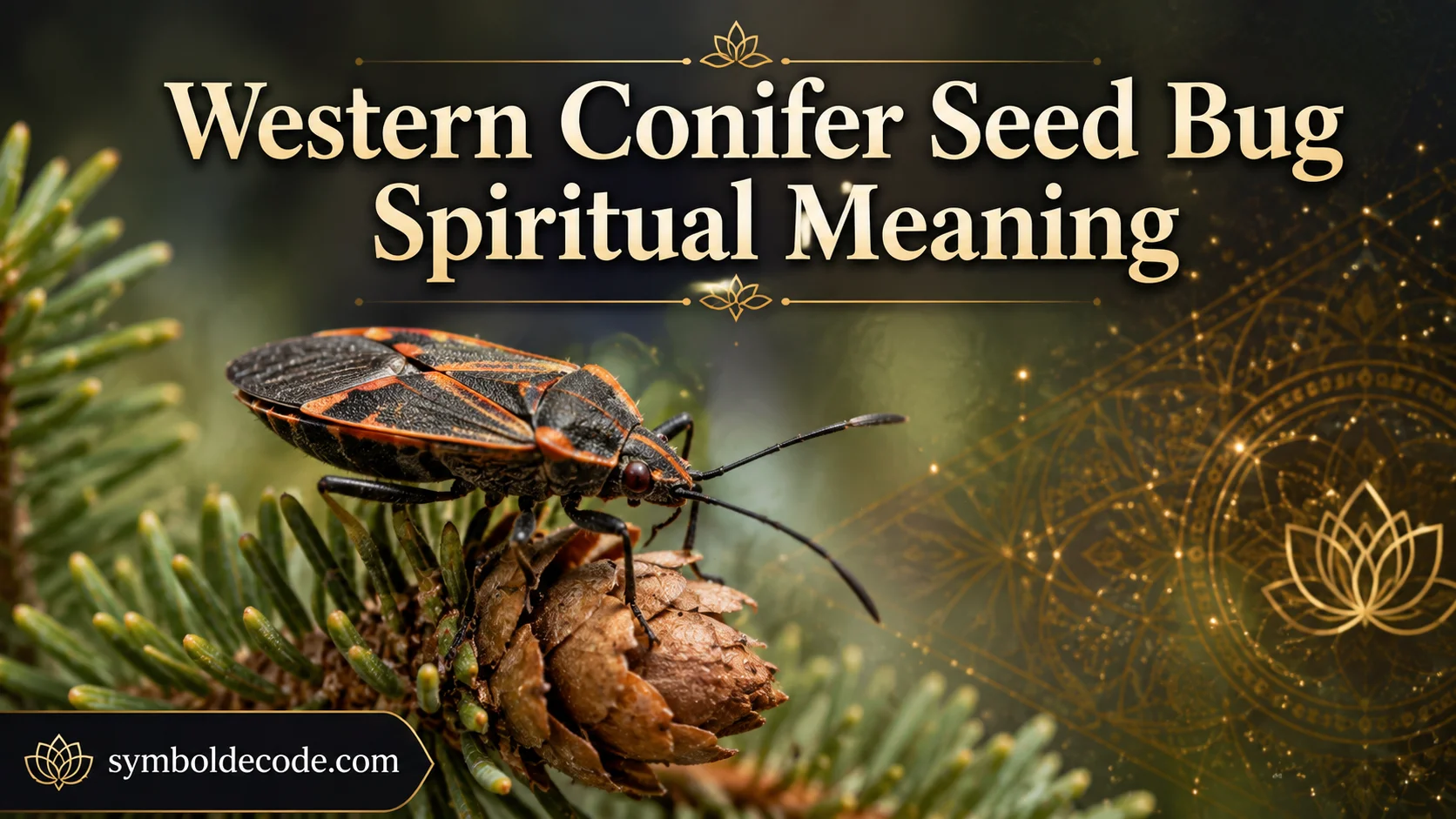
The Western conifer seed bug is a leaf-footed bug scientifically known as Leptoglossus occidentalis. Adults are generally reddish-brown to dull brown, with long antennae and distinctive leaf-like expansions on their hind legs.
Although its name sounds mysterious, the insect has a straightforward natural history. It feeds mainly on conifer seeds, cones, needles, and related plant material.
Distinctive Appearance
Its appearance can contribute to symbolic interpretations because several features stand out.
The body is narrow and brown, while a pale zigzag marking crosses its wings. When the insect flies, yellow-orange coloring may become visible on its abdomen.
Its unusual hind legs also have flattened, leaf-like sections. These details can inspire symbolic ideas about camouflage, awareness, balance, and connection with nature.
Why People Notice It
Most people don’t spend much time thinking about this insect until it appears indoors.
In many parts of the United States, adults move toward buildings during fall as they look for protected places to overwinter. That sudden appearance can make an ordinary seasonal behavior feel meaningful.
Western Conifer Seed Bug Symbolism and Core Meanings
The strongest symbolic interpretations come from observing what this insect actually does. Rather than assigning a supernatural message, we can use its natural traits as metaphors.
Adaptability
The bug’s ability to live across changing environments makes adaptability a natural theme. It doesn’t remain tied to one exact setting throughout the year.
Symbolically, this can suggest that flexibility isn’t weakness. Sometimes survival depends on changing your approach without abandoning your deeper values.
Resilience
Western conifer seed bugs survive seasonal changes by responding to their environment. They feed during warmer months and seek shelter as conditions become less favorable.
That pattern can represent resilience, especially when life becomes uncomfortable or uncertain.
Protection
When the insect enters a building, it isn’t necessarily attacking or invading in a symbolic sense. Biologically, it’s looking for shelter.
That behavior can inspire a message about protecting yourself, your household, your emotional space, or your personal boundaries.
Quiet Transformation
The insect develops through several life stages rather than changing dramatically like a butterfly. This creates a subtler metaphor.
Growth doesn’t always look dramatic. Sometimes transformation happens quietly through repeated adjustments.
Historical Roots of Insect Symbolism
The Western conifer seed bug itself doesn’t have a long documented spiritual tradition comparable to butterflies, scarabs, bees, or dragonflies. This distinction matters when discussing its symbolism.
Ancient Views of Insects
Human societies have interpreted insects symbolically for thousands of years. Their small size, unusual behavior, seasonal cycles, and ability to appear suddenly made them natural subjects of stories and beliefs.
Ancient Egyptian traditions famously gave scarabs important religious meaning. Greek literature also used insects and transformation as powerful symbolic themes.
However, these traditions shouldn’t automatically be transferred to the Western conifer seed bug. Different insects have different histories.
The Broader Symbol of Transformation
Insect symbolism often focuses on change because insects can pass through distinct stages of development.
That broad pattern helps explain why modern spiritual writers sometimes associate unfamiliar insects with personal growth. The Western conifer seed bug fits this modern interpretive pattern through its seasonal life cycle and changing surroundings.
Why the Conifer Matters
The insect’s relationship with conifers adds another symbolic layer.
Evergreen trees remain green through winter, so they have often been associated with endurance, continuity, renewal, and life through difficult seasons.
The bug’s dependence on conifers therefore creates a useful metaphor: small forms of life can remain connected to sources of strength even when the environment changes.
What Does the Western Conifer Seed Bug Mean in America?
In the United States, the insect’s strongest symbolic connection comes from its relationship with seasonal change and the home.
Western conifer seed bugs are native to western North America. Beginning in the mid-20th century, their range expanded into many eastern states.
A Symbol of American Landscapes
The insect is closely connected with American pine and conifer landscapes. It can appear in forests, yards, gardens, and around homes.
For an American reader, that makes its symbolism more grounded than exotic. It represents an encounter with ordinary nature close to home.
The Meaning of Entering a House
Finding one indoors may feel strange, especially when several appear near windows or walls.
Symbolically, however, this behavior can be interpreted as a reminder to examine your own relationship with home.
Possible reflections include:
- Creating stronger emotional boundaries
- Making your home feel more peaceful
- Knowing when to withdraw
- Preparing for difficult seasons
- Protecting what matters most
The important point is that these are reflective interpretations, not established American religious beliefs.
Western Conifer Seed Bug Spiritual Meaning in Different Contexts
The meaning can change depending on where and how you encounter the insect. Context often matters more than the insect alone.
Seeing One Outdoors
An outdoor encounter may emphasize nature, awareness, and grounding.
Because the insect is closely connected with conifers, seeing it near a pine or fir can encourage attention to the natural world around you.
Finding One Indoors
An indoor encounter can suggest themes of safety and boundaries.
You might use the moment as a reminder to ask whether your current environment supports rest, growth, and emotional stability.
Seeing Several Bugs
A group may draw attention to repeated patterns rather than one isolated event.
Instead of assuming that multiple insects predict something, consider whether a particular issue in your life has been asking for attention repeatedly.
Finding One During Autumn
Autumn provides a particularly strong symbolic setting.
The season itself represents transition, preparation, release, and movement toward a quieter period. The bug’s search for shelter can reinforce those themes.
Spiritual Meaning of a Western Conifer Seed Bug in Your House
Finding a Western conifer seed bug in your house can feel more significant than seeing one outdoors. That’s partly because the home has strong emotional meaning in American culture.
A house usually represents privacy, security, family, rest, and personal identity.
Protection and Boundaries
The most natural spiritual interpretation involves protection.
The insect enters a structure because it seeks shelter from colder conditions. Symbolically, this can remind you that protecting yourself isn’t selfish.
Healthy boundaries can create the space needed for recovery and growth.
Rest Before the Next Season
The insect’s seasonal behavior can also represent preparation.
There are periods when pushing harder isn’t the answer. Sometimes slowing down, gathering strength, and waiting for better conditions is wiser.
A Gentle Reminder
If you repeatedly notice one around your home, you don’t have to treat it as a supernatural warning.
Instead, you can use the encounter as a prompt for reflection. Ask yourself, Where do I need more safety, patience, or stability right now?
Read More: Candle Wick Mushroom Spiritual Meaning
Conifer, Pine, and Seed Symbolism
The words “conifer” and “seed” add important layers to this interpretation.
Conifers are often associated with endurance because many remain green across winter. Seeds, meanwhile, represent potential because they contain the beginning of future growth.
Conifer as Endurance
Evergreen imagery has long supported ideas of continuity and life through difficult seasons.
In several Native American traditions, pine trees have held important meanings, although those meanings differ between nations and communities. Some traditions associate pine with longevity, wisdom, harmony, peace, or sacred uses.
These traditions shouldn’t be treated as one single “Native American meaning.” Indigenous cultures are diverse, and symbolic traditions vary.
Seed as Potential
A seed represents something that isn’t fully visible yet.
That makes it a useful metaphor for hidden potential, patience, and future development.
When combined with the insect, the symbolism can become:
Protect what is growing before expecting it to become visible.
A Simple Symbolic Pattern
| Natural Feature | Symbolic Idea | Modern Reflection |
| Conifer connection | Endurance | Stay grounded during change |
| Seed feeding | Potential | Protect developing goals |
| Autumn shelter | Protection | Respect personal boundaries |
| Leaf-like legs | Adaptation | Adjust without losing yourself |
| Seasonal movement | Transition | Prepare for a new chapter |
Emotional and Psychological Meaning
Symbolism can work psychologically because people naturally search for meaning in unusual experiences.
Seeing an unfamiliar insect may create curiosity, discomfort, surprise, or even fascination. Your emotional reaction can become part of the interpretation.
If You Feel Calm
A calm response may make the encounter feel like a grounding moment.
You might connect it with patience, nature, or acceptance of seasonal change.
If You Feel Uncomfortable
Discomfort can point toward a different reflection.
Perhaps something unfamiliar has entered your life, and you’re unsure how to respond. The bug can become a metaphor for adapting instead of immediately resisting.
If You Feel Curious
Curiosity may be the most useful response.
Instead of assuming that every encounter carries a fixed message, curiosity lets you explore what the experience means personally.
What the Bug Can Symbolize During Life Changes
The Western conifer seed bug can serve as a useful metaphor during transitions because its life depends on responding to environmental conditions.
Career or Lifestyle Changes
A major change can make familiar surroundings feel uncertain.
The insect’s symbolism encourages flexibility. You can adapt while still keeping your core values intact.
Relationship Changes
Changes in relationships can also raise questions about boundaries and safety.
Its shelter-seeking behavior can inspire reflection on whether your relationships provide enough trust, respect, and emotional space.
Personal Growth
Growth isn’t always dramatic.
Sometimes it means becoming more observant, more patient, or more willing to change direction.
Western Conifer Seed Bug in Dreams
Dream symbolism is highly personal, so there isn’t one universal meaning for dreaming about this insect.
Still, its natural characteristics can provide useful themes.
Seeing the Bug
A bug appearing in a dream may represent something small that has captured your attention.
The question isn’t necessarily, “What does this insect predict?” A better question is, “What small issue am I overlooking?”
A Bug Entering Your Home
This dream image can symbolize boundaries.
It might reflect a situation that feels like it’s entering your private emotional space.
A Bug Leaving
A departing insect may suggest release, movement, or the end of a temporary concern.
Again, the emotional tone of the dream matters more than a fixed dictionary definition.
Modern Spiritual and Cultural Uses
Today, people often create symbolic meaning through social media, artwork, tattoos, journaling, meditation, and personal rituals.
The Western conifer seed bug isn’t a major traditional tattoo symbol. However, its unusual shape can appeal to people interested in less common nature imagery.
Tattoos and Artwork
A realistic insect design may represent resilience or a connection with forests.
Adding pine needles, cones, mountains, or evergreen branches can strengthen themes of nature and endurance.
Home Decor
Natural insect imagery can fit rustic, woodland, botanical, or nature-focused interiors.
In that setting, the bug may represent appreciation for overlooked parts of the natural world.
Social Media
Online spiritual communities often give symbolic meanings to encounters with animals and insects.
These interpretations can spread quickly, but popularity doesn’t make them ancient or universally accepted. Treat online interpretations as modern perspectives rather than established historical facts.
Misunderstandings and Controversies
The Western conifer seed bug is frequently misunderstood because people confuse it with other insects.
It Isn’t a Kissing Bug
The resemblance to some other brown insects can cause unnecessary concern.
Extension experts identify the Western conifer seed bug as a harmless nuisance insect that doesn’t bite people or transmit disease.
It Isn’t a Traditional Spiritual Symbol
There is no strong historical record showing that ancient civilizations assigned a specific spiritual meaning to Leptoglossus occidentalis.
The species was formally described in 1910. Modern spiritual interpretations are therefore much newer than many traditions involving insects such as scarabs or butterflies.
Spiritual Meaning Is Interpretive
A symbolic interpretation can be meaningful without being a proven supernatural fact.
That distinction allows people to explore spirituality while remaining grounded in natural history.
How the Meaning Has Changed Over Time
The insect’s story is unusual because its geographic history is relatively recent.
From Western North America
The species is native to western North America, where it developed alongside conifer ecosystems.
Its original geographic association helps explain the “western” part of its common name.
Expansion Across the United States
The species began spreading eastward during the 20th century. Today, it is established across a much broader portion of North America.
This movement itself can support a modern metaphor about adaptation and changing environments.
From Pest to Symbol
Most people encounter the bug because it enters buildings in cooler months.
However, modern spiritual writing has increasingly turned ordinary encounters with nature into opportunities for reflection. That’s where themes such as resilience, protection, and transformation have become attached to the insect.
How to Reflect on a Western Conifer Seed Bug Encounter
If you want to explore the symbolism personally, you don’t need a complicated ritual.
Start by observing the circumstances surrounding the encounter.
Ask Yourself Simple Questions
Consider these prompts:
- What was happening in my life when I noticed it?
- Am I currently adapting to a major change?
- Where do I need stronger boundaries?
- What part of my life needs patience?
- What am I protecting or preparing to grow?
These questions keep the interpretation personal rather than treating symbolism as a prediction.
Look at the Season
Seasonal context can add another layer.
An autumn encounter naturally connects with preparation, transition, and retreat. A spring encounter may feel more connected with emergence and renewed activity.
Notice Your Reaction
Your emotional response can be more revealing than the insect itself.
If you felt peaceful, curious, startled, or uncomfortable, that reaction may point toward what the encounter represents for you.
FAQs:
Is the Western Conifer Seed Bug a Good Spiritual Sign?
It can be viewed positively when interpreted as a symbol of resilience, adaptability, and protection. However, there is no universal spiritual rule that classifies the insect as either good or bad.
What Does It Mean When a Western Conifer Seed Bug Enters Your House?
Symbolically, it can represent seeking safety, creating boundaries, or preparing for a difficult season. In nature, the insect enters buildings mainly to find protected places during colder weather.
Does a Western Conifer Seed Bug Mean Change Is Coming?
Some modern spiritual interpretations connect the insect with change because of its seasonal movement and adaptability. Still, seeing one doesn’t scientifically predict a future event.
What Does a Western Conifer Seed Bug Symbolize in Dreams?
It may symbolize something small that deserves attention, especially if the dream focuses strongly on the insect. The meaning depends on the dream’s setting and your feelings during it.
Are Western Conifer Seed Bugs Dangerous?
They are generally considered harmless to people and are mainly viewed as nuisance insects when they enter buildings. They don’t bite or sting people.
Why Do Western Conifer Seed Bugs Come Inside?
Adults seek sheltered locations as temperatures fall, particularly during late summer and autumn. Buildings can provide protection from cold weather and drying conditions.
Conclusion:
Western Conifer Seed Bug Spiritual Meaning is best understood as a modern symbolic interpretation inspired by nature. Its behavior naturally suggests adaptability, resilience, protection, patience, and quiet transformation. Its connection with conifers adds another layer of meaning, where evergreen trees represent endurance and seeds suggest hidden potential and future growth. Together, these ideas create a simple message: protect what matters, adapt when conditions change, and give growth enough time. If you encounter this unusual bug, you don’t need to treat it as a supernatural prediction; instead, let it become a small reminder to notice your surroundings and reflect on where you may need greater resilience, stronger boundaries, or a little more patience.